
Introduction
Choosing a 20L dehumidifier for warehouse use means balancing extraction capacity, coverage area, energy draw, drainage setup, and real-world reliability in damp, high-traffic spaces. This article explains where 20-liter units make sense, especially for localized drying in storage rooms, packing zones, archives, and other moisture-sensitive areas rather than full-scale industrial halls. You’ll learn which performance specs matter most, how operating conditions affect actual water removal, and what features improve day-to-day warehouse use, from continuous drainage to mobility and humidity control. With that context, it becomes easier to compare models and identify the best fit for targeted warehouse drying solutions.
Why 20L Dehumidifiers Are Gaining Attention for Warehouse Drying
Moisture control in warehousing is critical to preventing inventory degradation, packaging failures, and mold growth. While large-scale industrial desiccant systems dominate massive distribution centers, light-duty commercial units are increasingly recognized for their versatility and targeted performance.
Specifically, units rated for 20 liters of moisture extraction per day (typically measured at 30°C and 80% relative humidity) offer a unique balance of portability, energy efficiency, and operational effectiveness. Facility managers are leveraging these mid-capacity systems to address localized humidity challenges without incurring the high capital expenditures associated with centralized HVAC overhauls.
Where 20L units fit light-duty warehouse drying
In vast warehouse environments, moisture issues are rarely uniform. Certain zones—such as tool cribs, archival record storage, or specialized electronics holding areas—often require stricter humidity parameters than the general ambient space. A standard 20-liter unit is optimally sized to manage these micro-climates, efficiently servicing enclosed areas ranging from 30 to 60 square meters.
By isolating sensitive goods in smaller rooms or partitioned zones, operators can deploy these compact units to maintain a relative humidity (RH) between 45% and 55%. This localized approach prevents rust on metal components and preserves the structural integrity of corrugated cardboard packaging, which typically begins to lose load-bearing strength when ambient RH exceeds 65%.
Which warehouse conditions make 20L dehumidifiers practical
The practicality of a 20-liter system heavily depends on the warehouse’s thermal profile. Most units in this capacity class operate on a refrigerant-based compressor system, which excels in environments where temperatures remain above 15°C (59°F). In these conditions, the warm air holds more moisture, allowing the cold evaporator coils to extract condensation at peak efficiency.
Conversely, if the warehouse is unheated and frequently drops below 10°C, a standard compressor model will spend excessive time in defrost cycles, drastically reducing its daily extraction rate from the nominal 20 liters down to as little as 5 liters. For standard, temperature-controlled light industrial spaces, however, these units provide an exceptionally cost-effective method for stabilizing daily moisture fluctuations caused by bay doors opening or seasonal weather shifts.
How to Evaluate the Best 20L Dehumidifiers for Warehouse Use
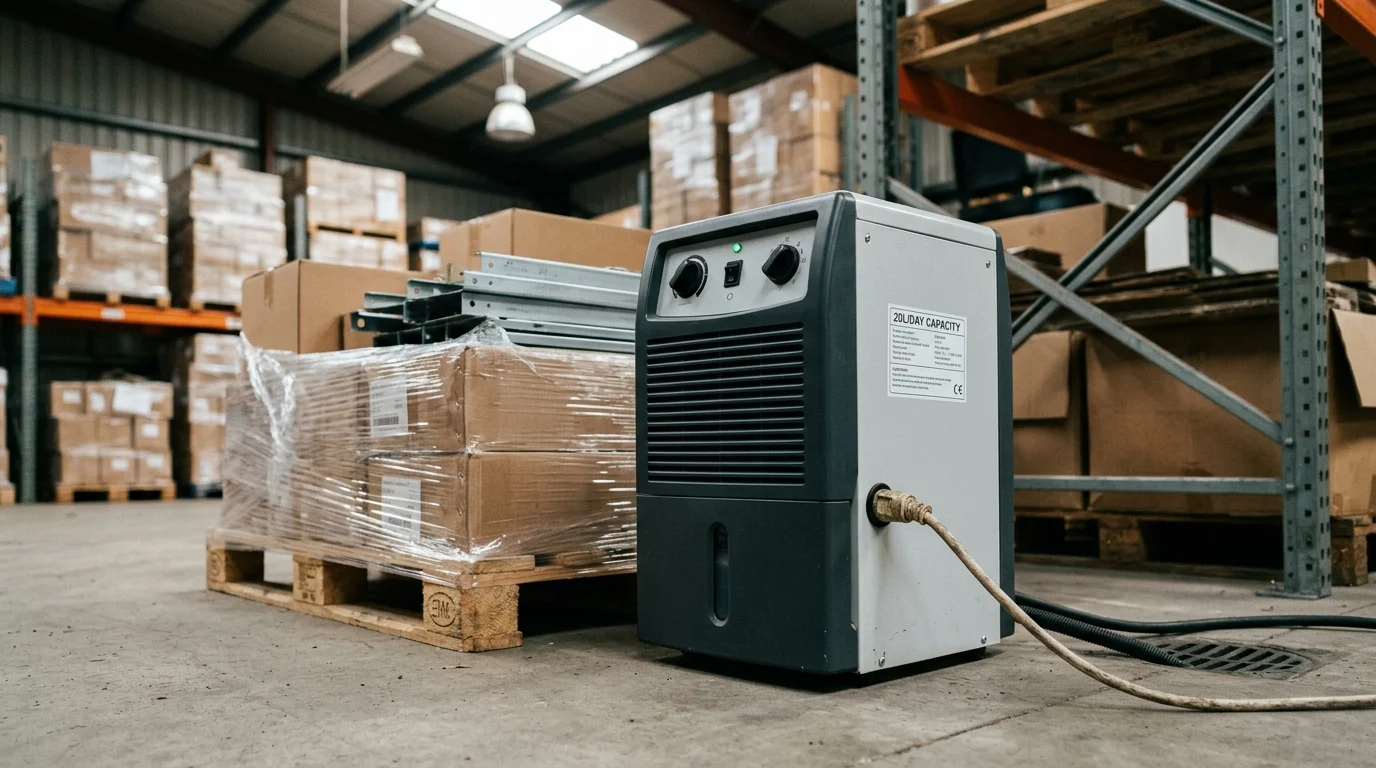
Selecting the appropriate equipment requires looking past the baseline capacity rating to understand the underlying mechanics that drive moisture removal. Facility operators must scrutinize specific technical parameters to ensure the unit aligns with their operational demands.
Which performance specifications matter most
The headline specification of 20 liters per day is almost universally measured at saturation conditions (30°C and 80% RH). However, buyers must evaluate the Association of Home Appliance Manufacturers (AHAM) rating, which measures performance at a more realistic 26.7°C (80°F) and 60% RH. Under AHAM conditions, a nominal 20-liter unit may extract closer to 10 or 12 liters daily.
Understanding this discrepancy is vital for accurate capacity planning. If a warehouse zone requires the removal of exactly 15 liters of water daily at 20°C and 55% RH, a single 20-liter machine will fall short, necessitating either a larger commercial unit or multiple 20-liter systems working in tandem.
How to compare airflow, drainage, and tank capacity
Airflow determines how quickly the machine can process the room’s volume. For a 20-liter capacity, a minimum airflow of 150 to 200 cubic meters per hour (m³/h) is required to ensure adequate air turnover in a 50-square-meter room. Insufficient airflow leads to localized dry pockets around the machine while distant corners remain damp.
Drainage logistics are equally critical. While standard models feature internal condensate tanks ranging from 4 to 6 liters, relying on manual emptying is highly inefficient for 24/7 warehouse operations. A tank of this size will fill in under 8 hours at peak extraction, triggering the auto-shutoff switch. Therefore, continuous gravity drainage ports or integrated condensate pumps capable of pushing water up to 3 meters vertically are essential for uninterrupted operation.
Which criteria separate entry-level and commercial models
The distinction between consumer-grade and commercial-grade models in the 20-liter category comes down to component durability and automated features designed for low-intervention environments.
| Feature / Specification | Entry-Level Consumer Model | Light-Commercial Model |
|---|---|---|
| Housing Material | ABS Plastic | Powder-coated steel or Rotomolded polyethylene |
| Defrost System | Passive fan defrost | Active hot gas bypass (operates down to 5°C) |
| Drainage | 4L internal tank only | Gravity port + optional 3m lift condensate pump |
| Humidistat Control | Dial or basic digital (+/- 10%) | Precision digital (+/- 5%) with auto-restart |
| Duty Cycle | 8-12 hours / day | 24/7 continuous operation rated |
How to Compare Build Quality, Compliance, and Maintenance
Beyond baseline performance, the total cost of ownership is dictated by the equipment’s physical resilience, adherence to safety regulations, and the ease with which maintenance teams can service the unit.
Which build features indicate reliability
Warehouse environments are inherently harsh, subject to dust, forklift traffic, and fluctuating temperatures. Units featuring powder-coated steel or rotomolded housings are significantly more resistant to impact damage than those made from injection-molded plastics.
Internally, the use of hydrophilic-coated evaporator coils prevents dust accumulation and corrosion, maintaining heat exchange efficiency over time. Furthermore, the adoption of R290 (propane) refrigerant is a strong indicator of modern build quality, offering excellent thermodynamic properties and a Global Warming Potential (GWP) of just 3, making it highly efficient and environmentally sustainable.
Which certifications and electrical standards matter
Electrical safety cannot be compromised in commercial settings. Procurement teams must verify that the equipment carries recognized safety certifications such as CE, RoHS, UL, or ETL, depending on the regional market. These marks ensure the wiring and internal compressors meet strict fire safety and operational standards.
Ingress protection is another critical metric. An IPX4 rating indicates the unit is protected against splashing water from any direction, which is necessary if the warehouse undergoes periodic washdowns or handles liquid inventory. Some industrial variants push this to IPX5 for enhanced protection against low-pressure water jets.
How to assess maintenance, spare parts, and warranty
Maintenance accessibility directly impacts the lifespan of the equipment. High-quality units feature slide-out, washable polyurethane filters that require cleaning every 3 to 6 months to maintain optimal airflow. Models that require full casing disassembly just to access the filter will inevitably suffer from neglect and subsequent compressor failure.
Warranty structures also reflect build confidence. A standard commercial warranty should offer at least 1 year on parts and labor, with 3 to 5 years of coverage explicitly for the sealed refrigeration system (compressor, condenser, and evaporator). Buyers should also confirm the domestic availability of replacement parts, specifically humidistat sensors and fan motors, to avoid extended downtime.
How to Source and Deploy 20L Dehumidifiers Effectively
Acquiring and installing humidity control equipment requires strategic planning to maximize efficiency and secure the best return on investment for the facility.
How buyers should evaluate suppliers and purchasing options
When sourcing equipment, facility managers must evaluate the supplier’s capacity to handle B2B demands. Purchasing directly from manufacturers or specialized industrial distributors often unlocks favorable pricing structures, especially when Minimum Order Quantities (MOQs) range from 50 to 100 units for multi-facility deployments. Lead times for wholesale orders typically span 30 to 45 days, requiring advance procurement ahead of seasonal humidity spikes.
Buyers should also seek suppliers that provide comprehensive technical documentation, including CAD blocks for facility planning and transparent AHAM performance data. Engaging with reputable suppliers of 20L dehumidifiers ensures access to commercial-grade warranties and reliable after-sales support networks.
Which deployment steps improve drying performance
Proper installation is vital for achieving the machine’s rated extraction capacity. Units must be positioned with a minimum clearance of 50 centimeters on all sides to prevent airflow restriction at the intake and exhaust louvers. Placing a unit tightly against a wall or nestled between inventory pallets can cause short-cycling, where the machine re-ingests its own dry exhaust air.
Furthermore, the target area must be adequately sealed. Operating a unit in a bay with open dock doors is highly inefficient, as the machine will continuously battle incoming ambient moisture. Utilizing vinyl strip curtains or high-speed roll-up doors can successfully isolate the drying zone, allowing the dehumidifier to stabilize the internal environment effectively.
When to use multiple 20L dehumidifiers
In complex warehouse layouts featuring high-density racking systems, relying on a single large-capacity unit (e.g., a 60-liter or 100-liter machine) can lead to uneven drying. Racking acts as a baffle, obstructing airflow and creating stagnant micro-climates where mold can thrive.
In these scenarios, deploying multiple 20-liter units in a distributed network is often superior. For instance, placing three 20-liter units at strategic intervals along the perimeter of a 150-square-meter racking zone establishes cross-ventilation and ensures uniform moisture extraction. This decentralized approach also builds redundancy into the system; if one unit requires maintenance, the remaining machines continue to provide baseline humidity control.
How to Match 20L Dehumidifiers to Warehouse Needs
Ultimately, the effectiveness of any moisture control strategy relies on accurately aligning the equipment’s capabilities with the specific environmental challenges and operational goals of the facility.
Which buyer profiles should prioritize key features
Different warehouse applications dictate distinct feature priorities. Archive managers and pharmaceutical storage operators, who must adhere to strict regulatory compliance, should prioritize models with precision digital humidistats capable of maintaining RH within a tight +/- 5% tolerance. These users also require auto-restart functionality to ensure the system recovers its settings immediately following a power grid failure.
Conversely, logistics managers overseeing general goods storage may prioritize rugged housing and high-lift condensate pumps over micro-precision controls. For these applications, the ability to run unattended for weeks via continuous drainage is paramount. Exploring a specialized catalog of 20L dehumidifiers can help buyers identify the specific configurations that match their daily operational demands. For custom integration queries, reaching out via a dedicated 20L dehumidifiers portal ensures expert guidance.
How to match units to warehouse size and humidity levels
To prevent over-investment or under-performance, facility managers should calculate their requirements based on room volume, baseline insulation, and the severity of the moisture ingress. The following matrix provides a baseline for matching a single 20-liter unit to various warehouse environments.
| Warehouse Condition | Target RH | Max Room Volume (m³) | Max Floor Area (approx. m²) |
|---|---|---|---|
| Well-Sealed / High Insulation | 50% – 55% | 150 m³ | 60 m² |
| Average Sealing / Daily Access | 45% – 50% | 100 m³ | 40 m² |
| Poorly Sealed / High Ingress | 40% – 45% | 50 m³ | 20 m² |
| Cold Storage (10°C – 15°C) | 50% | 40 m³ | 15 m² |
Further reading:
Key Takeaways
- The most important conclusions and rationale for 20L dehumidifiers
- Specs, compliance, and risk checks worth validating before you commit
- Practical next steps and caveats readers can apply immediately
Frequently Asked Questions
What warehouse areas are best suited to a 20L dehumidifier?
They work best in enclosed warehouse zones of about 30–60 m², such as tool cribs, archive storage, packaging rooms, and electronics holding areas.
Can a 20L dehumidifier dry an entire warehouse?
Usually no. A 20L unit is better for localized humidity control, not whole-warehouse drying unless the space is small and partitioned.
What humidity level should a 20L dehumidifier maintain in storage areas?
Aim for 45%–55% RH to help protect metal parts from rust and keep cardboard packaging from weakening.
Which features matter most when choosing a 20L warehouse dehumidifier?
Check real-world capacity, airflow around 150–200 m³/h, and continuous drainage or a condensate pump for uninterrupted operation.
How can Cetus Dry help with selecting a 20L dehumidifier?
You can review Cetus Dry product options and contact their team to match capacity, drainage, and operating temperature to your warehouse zone.