
Introduction
Finding a strong online deal on a 10L home dehumidifier takes more than comparing sticker prices. Retailers often vary widely on delivery fees, seasonal discounts, bundled warranties, and energy-efficiency claims, all of which affect the true value of a purchase. This article breaks down where shoppers are most likely to see competitive pricing, which store types tend to offer better promotions, and what product details matter most before checkout. By the end, you’ll have a clearer way to compare offers and avoid overpaying for a compact dehumidifier that fits your room size, humidity level, and running-cost expectations.
Why 10L Home Dehumidifiers Are in High Demand
The market for compact environmental control appliances has expanded rapidly, with 10L home dehumidifiers emerging as a preferred choice for urban dwellers and homeowners alike. These units are engineered to extract 10 liters of moisture per day under standard testing conditions (typically 30°C and 80% relative humidity), striking an optimal balance between physical footprint and extraction capability.
Unlike industrial or whole-house systems that require significant investment and space, these mid-capacity models address localized humidity issues effectively. Understanding the market dynamics behind their popularity is the first step in identifying high-value purchasing opportunities.
Seasonal demand and energy cost trends
The surge in demand for moisture control appliances is heavily influenced by seasonal shifts and the rising cost of residential energy. During late autumn and winter, indoor condensation becomes a primary catalyst for mold growth, prompting consumers to seek efficient drying solutions. Simultaneously, escalating electricity tariffs have made energy consumption a critical purchasing factor.
Standard central HVAC systems or high-capacity dehumidifiers can draw upwards of 600W to 800W. In contrast, modern 10L home dehumidifiers typically operate on a highly efficient 150W to 250W power draw. This lower energy requirement allows households to run the units continuously during high-humidity seasons without incurring exorbitant utility bills, making them an economically viable alternative to relying solely on central heating to dry out damp air.
Best use cases for small spaces
Compact 10L units are specifically optimized for enclosed environments ranging from 15 to 20 square meters (approximately 160 to 215 square feet). Their form factor makes them highly suitable for targeted applications rather than open-plan living areas. Common deployments include unventilated bathrooms, small bedrooms, and dedicated laundry drying rooms where localized moisture generation is exceptionally high.
| Room Size (sq m) | Typical Application | Recommended Capacity |
|---|---|---|
| 5 – 10 | Bathrooms, Walk-in Closets | 5L – 10L |
| 10 – 20 | Small Bedrooms, Laundry Rooms | 10L – 12L |
| 20 – 30 | Master Bedrooms, Living Rooms | 12L – 20L |
By matching the appliance capacity strictly to the room size, buyers avoid the inefficiency of overworking a smaller 2L Peltier unit or overpaying for a 20L compressor model that exceeds the spatial requirements.
Key Specifications to Compare
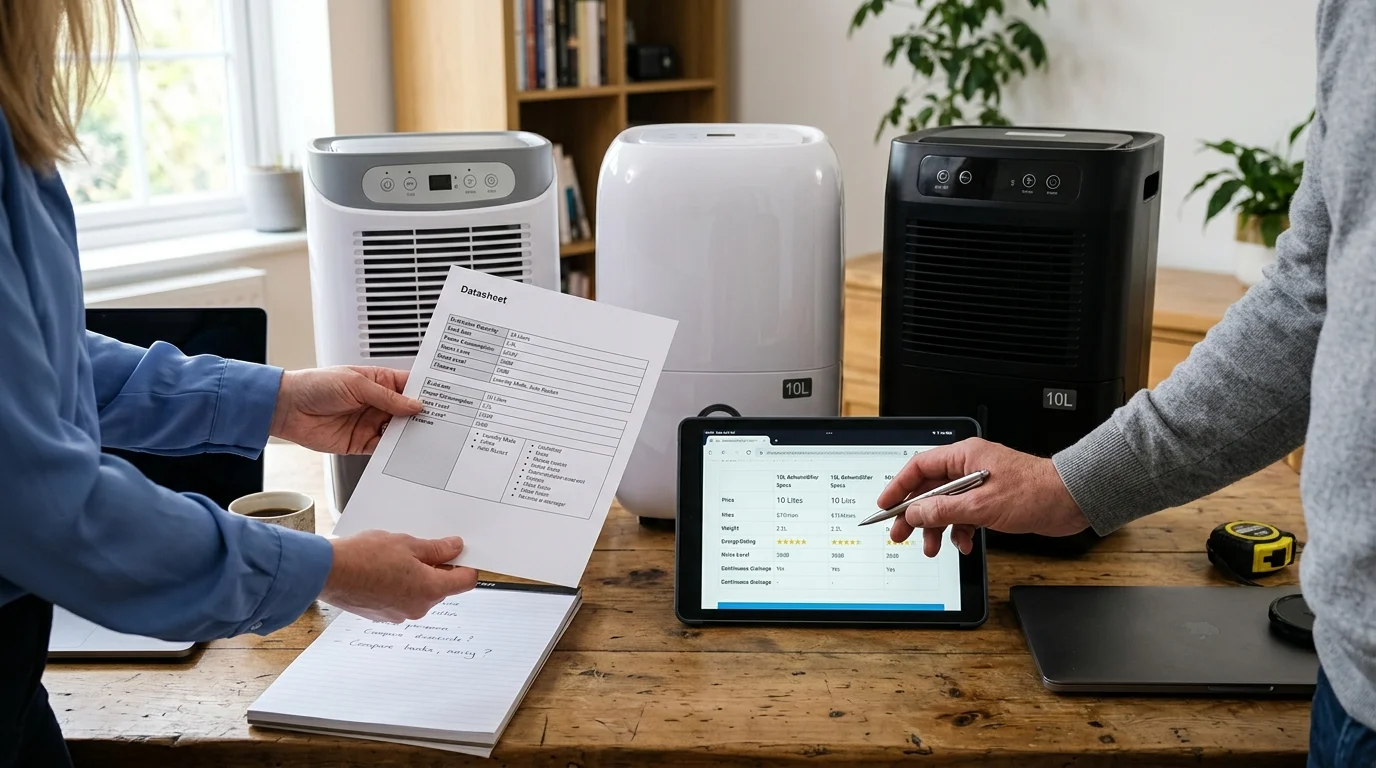
Securing a favorable deal online requires looking past promotional banners to evaluate the technical specifications that dictate daily performance. A competitively priced unit is only a bargain if its hardware aligns with the buyer’s environmental needs and operational expectations.
Performance metrics that matter
Beyond the headline 10L extraction rate, several secondary metrics define the usability of a dehumidifier. The internal water tank capacity is paramount; most 10L units feature reservoirs ranging from 1.5L to 2.5L. A smaller tank necessitates emptying two to three times a day in highly damp conditions, whereas a 2.5L tank offers longer autonomous operation. Models equipped with continuous drainage hoses bypass this limitation entirely.
Acoustic performance is another critical metric, particularly for bedroom or home office deployment. High-quality 10L models typically operate between 35 dB and 45 dB on their lowest fan settings. Anything exceeding 50 dB is generally considered disruptive for residential living spaces, diminishing the appliance’s overall value regardless of its retail price.
Compressor vs desiccant models
The internal extraction technology fundamentally alters the appliance’s efficiency across different climates. The market is divided into compressor-based and desiccant-based architectures.
| Feature | Compressor Models | Desiccant Models |
|---|---|---|
| Optimal Temperature | Above 15°C (59°F) | 1°C to 15°C (34°F – 59°F) |
| Average Power Draw | 150W – 250W | 300W – 400W+ |
| Noise Level | 35 dB – 45 dB | 30 dB – 40 dB |
| Weight | Heavier (9 – 12 kg) | Lighter (5 – 8 kg) |
Compressor models utilize refrigerants to cool internal coils and are highly effective in standard room temperatures (above 15°C). Desiccant models use a rotating wheel of moisture-absorbing material and an internal heater, making them superior for unheated spaces like garages or cellars, though they consume significantly more electricity.
Ownership costs and energy efficiency
The initial purchase price represents only a fraction of the total cost of ownership. Energy efficiency dictates the long-term financial viability of the appliance. For instance, a 200W compressor unit running 8 hours a day consumes 1.6 kWh. At an average electricity rate of $0.15 per kWh, the daily running cost is roughly $0.24, equating to $7.20 per month.
When comparing deals, a unit priced $30 lower but drawing an additional 100W will erase its initial savings within the first six months of continuous operation. Buyers must calculate this baseline operational expenditure when evaluating online discounts.
Where to Find the Best Online Deals
The digital marketplace offers diverse avenues for purchasing environmental control appliances. Navigating the myriad of e-commerce platforms, direct manufacturer portals, and digital storefronts of traditional retailers is essential for securing discounts that frequently range from 15% to 30% off the manufacturer’s suggested retail price (MSRP).
Marketplaces vs brand-direct and retail stores
Major online marketplaces such as Amazon, eBay, and regional equivalents provide extensive variety, aggressive pricing algorithms, and expedited shipping logistics. However, they can also be cluttered with white-label units of varying quality. Conversely, buying directly from a manufacturer’s website or learning more about specialized 10L home dehumidifiers often yields distinct advantages, such as extended warranty periods, guaranteed authentic inventory, and bundled accessories like replacement HEPA filters.
Traditional big-box home improvement retailers with robust online presences offer a hybrid approach. They typically stock vetted, recognizable brands and allow for easy in-store returns, though their baseline prices may sit 5% to 10% higher than pure e-commerce platforms.
Best times to buy
Timing the market is highly effective for appliance purchases. Retailers heavily discount dehumidifiers during major global sales events like Black Friday and Cyber Monday. However, cyclical seasonal trends offer equally lucrative opportunities.
The end of the damp winter season—typically March and April in the Northern Hemisphere—triggers clearance sales as retailers rotate inventory to make room for summer air conditioning units. During these off-season windows, a premium 10L unit with an MSRP of $150 can frequently be acquired for $85 to $100.
How to compare prices and offers
Effective price comparison requires evaluating the total landed cost rather than just the cart subtotal. Buyers must account for shipping fees, applicable digital sales taxes, and the inclusion of necessary accessories like continuous drainage hoses.
Utilizing browser extensions that track historical pricing data prevents consumers from falling for artificial discounts, where a retailer inflates the base price immediately before applying a “sale” percentage. True deals are verified by comparing the current promotional price against the appliance’s 90-day historical average.
How to Check Quality and Seller Reliability
Securing a low price is counterproductive if the appliance fails prematurely, operates inefficiently, or poses a hazard. Because 10L units involve both water collection and electrical components operating continuously, verifying manufacturing quality and vendor credibility is a non-negotiable phase of the purchasing process.
Certifications and safety standards
Regulatory compliance is the most objective indicator of appliance safety. Legitimate dehumidifiers will bear certification marks from recognized testing laboratories, such as UL (Underwriters Laboratories), ETL, or CE, depending on the target region. These marks confirm that the internal wiring and moisture protection mechanisms meet strict international standards.
Additionally, the type of refrigerant used is a critical specification. Modern, compliant units utilize R290, a highly efficient, eco-friendly hydrocarbon refrigerant with a minimal Global Warming Potential (GWP) of 3. Units operating near water sources, such as bathrooms, should also carry a minimum ingress protection rating of IPX4, ensuring the casing is resistant to splashing water.
Seller ratings and review authenticity
In online marketplaces, seller reputation is a proxy for product reliability. Buyers should prioritize vendors maintaining a minimum 95% positive feedback score across at least 1,000 transactions. It is equally important to scrutinize the written reviews for authenticity.
Patterns of generic, five-star reviews posted within a narrow timeframe often indicate manipulated ratings. Genuine reviews typically discuss specific operational details, such as the exact noise profile, the ease of removing the 2L water tank, or the accuracy of the built-in digital humidistat.
Shipping, packaging, and return terms
The logistics of delivering a compressor-based appliance require specialized handling. Compressors contain oil and refrigerants that must remain upright; if a unit is shipped on its side, it must stand upright for 24 hours before activation to prevent mechanical failure. Reliable sellers explicitly state these handling instructions in their shipping documentation.
Furthermore, buyers should verify return policies and warranty coverage before finalizing a transaction. A standard baseline is a 30-day no-questions-asked return window and a 1-year comprehensive manufacturer warranty. Reaching out to support channels regarding 10L home dehumidifiers prior to purchase is a practical method for testing a seller’s responsiveness and customer service infrastructure.
How to Choose the Best Deal
Synthesizing technical specifications, market timing, and seller verification leads to an optimized purchase decision. The final stage involves narrowing down the available options into a manageable shortlist and weighing the inherent trade-offs between upfront pricing and long-term utility.
A simple shortlist process
A streamlined shortlisting process involves filtering the market down to three specific models that meet the buyer’s absolute non-negotiables. First, eliminate any unit that lacks regional safety certifications or utilizes outdated refrigerants. Second, filter out models with a water tank capacity below 1.5L, as the frequent emptying will quickly become a nuisance in a 15-square-meter room.
Once three viable units are identified, consumers should chart their respective MSRPs against the current discounted prices. This side-by-side comparison highlights which specific brand is offering the highest percentage of genuine savings relative to its hardware quality and included warranty terms.
Balancing price, running cost, and delivery
The ultimate purchase decision rests on balancing three pillars: initial capital outlay, ongoing operational expenditure, and logistical convenience. A budget model priced at $90 but consuming 250W will cost significantly more over a three-year lifespan than a premium $130 model engineered to draw only 160W.
Furthermore, delivery timelines and return convenience hold monetary value. Paying a marginal 5% premium to purchase from a highly rated domestic supplier with a generous return policy is often a wiser investment than importing a slightly cheaper unit from a vendor with convoluted, high-friction return protocols. By prioritizing total lifecycle cost over the lowest immediate sticker price, buyers ensure they secure a deal that delivers sustained environmental comfort and financial efficiency.
Further reading:
Key Takeaways
- The most important conclusions and rationale for 10L home dehumidifiers
- Specs, compliance, and risk checks worth validating before you commit
- Practical next steps and caveats readers can apply immediately
Frequently Asked Questions
Where are the best online deals for 10L home dehumidifiers?
Compare brand stores, major marketplaces, and supplier sites like Cetusdry. The best value often comes from seasonal sales, bundle offers, and direct-from-manufacturer discounts with warranty support.
How do I know if a 10L dehumidifier is right for my room?
A 10L model usually suits spaces around 10 to 20 square meters, such as small bedrooms, bathrooms, or laundry rooms. Check your room size and humidity level before buying.
What specs should I compare before buying online?
Focus on daily extraction rate, power draw, tank size, noise level, and continuous drainage. For practical home use, look for about 150W to 250W power and 35 dB to 45 dB noise.
Is it better to buy a compressor or desiccant 10L dehumidifier?
Choose a compressor model for normal indoor rooms above 15°C to save energy. Pick a desiccant model for colder spaces like garages or cellars where low-temperature performance matters more.
How can I avoid overpaying for a 10L home dehumidifier online?
Check the real use case, not just the discount. Avoid paying extra for oversized capacity, and compare warranty terms, shipping costs, and included drain hose or filters on sites like Cetusdry.