
Introduction
Choosing the right dehumidifier comes down to more than room dimensions. Capacity is rated by how many pints of moisture a unit can remove in 24 hours, so the best size depends on square footage, ceiling height, current humidity, and whether the space is mildly damp or consistently wet. A unit that is too small may run constantly without bringing humidity into a healthy range, while one that is too large can cycle inefficiently and dry the air unevenly. This guide explains how to match dehumidifier capacity to your room conditions so you can improve comfort, control mold risk, and avoid wasting energy.
Why dehumidifier size matters
Determining what size dehumidifier is required for a specific environment is the foundational step in establishing effective moisture control. The capacity of these units is measured not by their physical dimensions, but by their extraction rate—the volume of water they can remove from the air over a 24-hour period. Selecting the incorrect capacity fundamentally compromises both the efficacy of moisture removal and the longevity of the equipment.
Impact on drying speed and comfort
The primary objective of environmental moisture control is maintaining relative humidity (RH) between 30% and 50%. When a unit is undersized for the spatial volume, it lacks the extraction rate to overcome natural moisture infiltration, leaving the environment vulnerable to mold proliferation, which accelerates at RH levels above 60%. Conversely, an oversized unit drops the ambient humidity too rapidly. This rapid extraction creates dry microclimates immediately surrounding the hardware while failing to draw out deep-seated moisture from porous materials like drywall, upholstery, and structural timber.
Effects on energy use and runtime
Equipment sizing directly dictates compressor cycling behavior and electrical consumption. An appropriately specified dehumidifier operates in sustained cycles of 45 to 55 minutes, maximizing the efficiency of the refrigeration loop. Undersized units are forced to run continuously, drawing a steady 400 to 700 watts without ever achieving the target setpoint, which leads to premature compressor failure. Oversized units experience short-cycling, shutting down in under 15 minutes. This constant toggling causes severe thermal and mechanical stress on the compressor components and spikes the starting amperage, ultimately increasing long-term energy expenditures despite shorter runtimes.
How to size a dehumidifier for a room
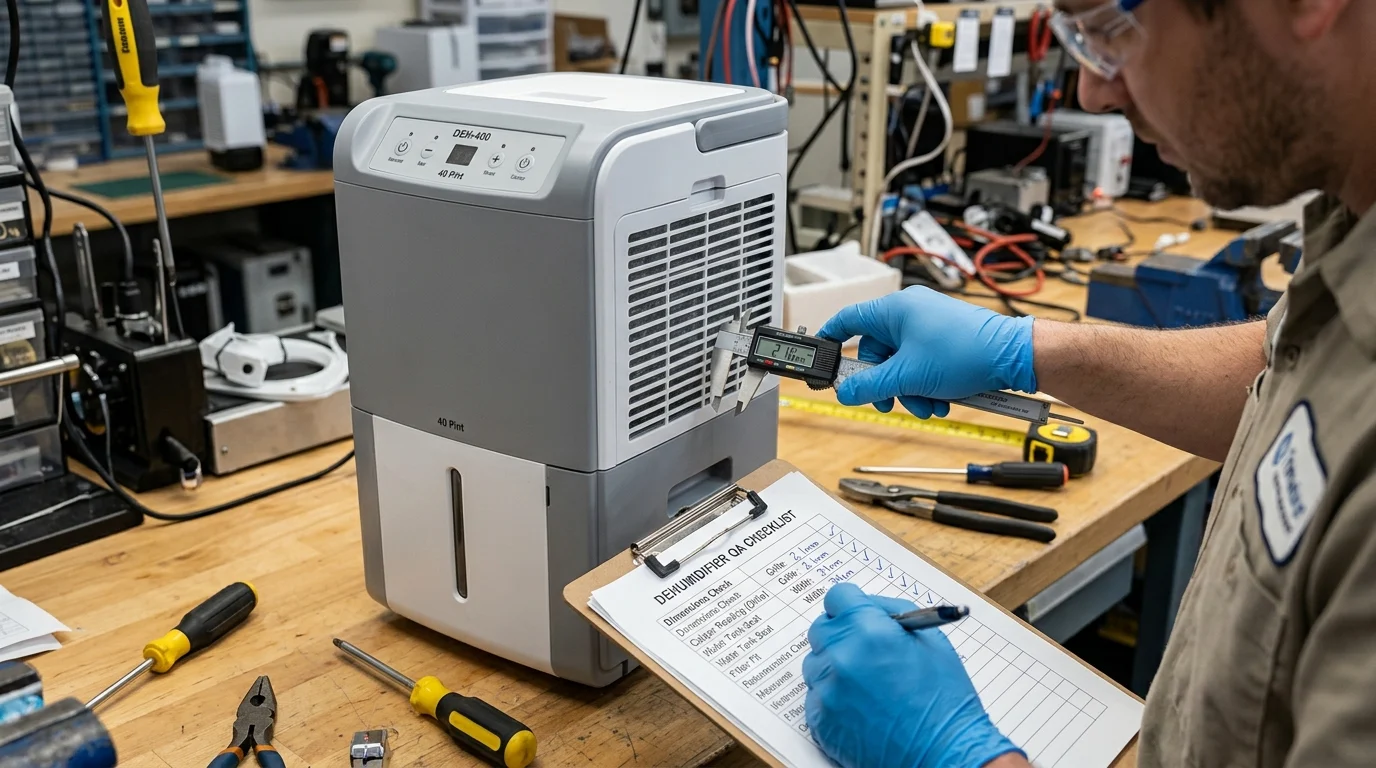
Accurate sizing requires evaluating both the physical dimensions of the space and the environmental variables that dictate the total moisture load. While manufacturers frequently market units based on square footage, relying exclusively on two-dimensional floor space invariably leads to miscalculations in high-volume or high-humidity environments.
Room size, ceiling height, and layout
Standard sizing methodologies operate on the assumption of an 8-foot ceiling height. However, total air volume (cubic footage) is the true metric that dictates extraction requirements. For instance, a 1,000-square-foot room with standard 8-foot ceilings contains 8,000 cubic feet of air. The same footprint with vaulted 12-foot ceilings contains 12,000 cubic feet—a 50% increase in air volume. This architectural variance necessitates a proportionate 50% increase in the unit's pint-per-day capacity to process the additional air mass effectively.
Moisture load, ventilation, and occupancy
The baseline moisture load is categorized into four distinct environmental conditions: Moderately Damp (musty odor during humid weather), Very Damp (visible moisture stains), Wet (sweating walls or weeping concrete), and Extremely Wet (standing water). Furthermore, human occupancy significantly alters the baseline. Moderate physical activity and respiration introduce approximately 0.5 pints of moisture per occupant daily. High-ventilation areas, such as rooms with poorly sealed windows or frequent door operations, introduce continuous ambient humidity that requires a higher extraction threshold to mitigate.
Recommended capacity by room type
Based on the Department of Energy (DOE) standardized testing criteria, capacity requirements scale predictably across different spatial footprints and dampness severities. The following matrix outlines the required extraction capacities for standard 8-foot ceiling environments.
| Square Footage | Moderately Damp | Very Damp | Wet | Extremely Wet |
|---|---|---|---|---|
| 500 sq. ft. | 20 Pints | 25 Pints | 30 Pints | 40 Pints |
| 1,000 sq. ft. | 25 Pints | 30 Pints | 40 Pints | 50 Pints |
| 1,500 sq. ft. | 30 Pints | 40 Pints | 50 Pints | 50+ Pints |
| 2,000 sq. ft. | 40 Pints | 50 Pints | 50+ Pints | Multiple Units |
How to compare dehumidifier capacity
Comparing hardware across different manufacturers requires a comprehensive understanding of how capacity ratings are standardized and certified. Without evaluating the underlying testing conditions, consumers risk purchasing legacy hardware that underperforms in real-world environments.
Pints per day and test conditions
The most critical shift in capacity evaluation occurred with the 2019 Department of Energy (DOE) regulatory update. Prior to 2019, extraction rates were tested at an ambient temperature of 80°F and 60% relative humidity. The updated standard mandates testing at 65°F and 60% RH to accurately simulate typical basement and crawlspace conditions, where temperatures are naturally lower. Because colder air holds less moisture, the extraction process is inherently less efficient at 65°F. Consequently, a unit certified as a 70-pint model under the legacy standards is functionally equivalent to a 50-pint model under the current DOE framework.
Useful features and performance specs
Beyond raw extraction volume, airflow velocity—measured in Cubic Feet per Minute (CFM)—is a vital performance specification. A standard 50-pint unit must maintain an airflow of at least 250 CFM to effectively turn over the air mass in a 1,500-square-foot space. Additional operational features directly impact sizing viability, such as integrated hygrometers with an accuracy tolerance of ±5% RH, and active auto-defrost mechanisms. For environments dropping below 41°F, auto-defrost is mandatory to prevent ice accumulation on the evaporator coils, which would otherwise halt the extraction cycle entirely.
How to calculate the right size
Translating environmental variables into a precise hardware specification requires a systematic mathematical approach. Bypassing these calculations often results in inefficient moisture management and inflated utility overhead.
Step-by-step sizing process
The calculation process begins by establishing the two-dimensional footprint (length multiplied by width). Next, apply a multiplier for ceiling height by dividing the actual ceiling height by the standard 8 feet (e.g., a 10-foot ceiling yields a 1.25 multiplier). Multiply the baseline square footage by this factor to determine the effective square footage. Finally, assess the moisture severity. If the space is classified as "Wet" rather than "Moderately Damp," standard industry practice dictates adding a 10-pint buffer to the baseline recommendation to account for continuous moisture ingress through the building envelope.
Common sizing mistakes
The most prevalent error in hardware selection is relying exclusively on the maximum square-footage claims printed on retail packaging, which are calculated under optimal, hermetically sealed laboratory conditions. Another frequent oversight is neglecting thermal operational bands. Operating a standard compressor-based unit in a 55°F unconditioned garage can reduce its extraction efficiency by up to 40% compared to its rated capacity at 65°F, necessitating a significantly larger unit or a specialized desiccant system to compensate for the thermal deficit.
When to choose more than one unit
Architectural layout is a hard constraint on single-unit efficacy. Internal walls, closed doors, and complex HVAC ducting severely restrict the 250+ CFM airflow required for whole-space extraction. When evaluating what size dehumidifier to deploy in spaces exceeding 2,500 square feet, or in basements partitioned into multiple isolated rooms, distributed capacity is superior to centralized capacity. Deploying two 30-pint units at opposite ends of a partitioned footprint establishes overlapping convective loops, yielding vastly superior moisture control compared to a single, centrally located 50-pint unit.
How to choose the best final option
The ultimate procurement decision must balance the calculated capacity requirements against operational efficiency, long-term durability, and the total cost of ownership. The correct size is not merely about moisture removal, but achieving that removal with optimal energy utilization.
Energy efficiency and warranty
Energy efficiency is a primary cost driver over the equipment's lifecycle. Units carrying the Energy Star certification consume approximately 15% less electricity than non-certified counterparts. When evaluating specifications, prioritize the Energy Factor (EF), which measures the liters of water extracted per kilowatt-hour (L/kWh) of energy consumed. An EF of 1.80 L/kWh or higher indicates a highly efficient compressor circuit. Additionally, verify the warranty structure; commercial-grade and high-capacity residential units typically offer a 1-year comprehensive warranty, supplemented by a crucial 5-year warranty covering the sealed refrigeration system (compressor, condenser, and evaporator).
Simple decision framework
To streamline the final selection, cross-reference the determined pint capacity with expected efficiency metrics and operational applications. The framework below illustrates the typical specifications and economic impacts associated with different capacity tiers.
| Unit Capacity (Current DOE) | Minimum Energy Factor | Ideal Application Environment | Est. Annual Operating Cost (Continuous Use) |
|---|---|---|---|
| 20 to 25 Pints | 1.30 L/kWh | Single bedrooms, small bathrooms (<500 sq. ft.) | $180 – $240 |
| 30 to 35 Pints | 1.60 L/kWh | Open living spaces, moderate basements (1,000 sq. ft.) | $250 – $310 |
| 50 to 60 Pints | 1.80 L/kWh | Large open basements, extremely wet zones (1,500+ sq. ft.) | $320 – $400 |
| Desiccant / Commercial | 2.00+ L/kWh | Cold climates (<50°F), crawlspaces, industrial applications | $450+ |
Key Takeaways
- The most important conclusions and rationale for what size dehumidifier
- Specs, compliance, and risk checks worth validating before you commit
- Practical next steps and caveats readers can apply immediately
Frequently Asked Questions
How do I know what size dehumidifier I need?
Match capacity to room size and dampness. For 500 sq. ft., use about 20 pints/day if moderately damp, 25 if very damp, 30 if wet, and 40 if extremely wet.
Does ceiling height affect dehumidifier sizing?
Yes. Most charts assume 8-foot ceilings. If your ceiling is 12 feet, increase capacity by about 50% because the room holds much more air.
Can I use square footage alone to choose a dehumidifier?
No. Also consider ceiling height, visible moisture, ventilation, and occupancy. A leaky, busy room usually needs a higher pint-per-day rating than a sealed room of the same size.
What happens if my dehumidifier is too small or too large?
Too small: it may run nonstop and never reach 30%–50% RH. Too large: it can short-cycle, waste energy, and dry the air unevenly near the unit.
What humidity level should I aim for in my room?
Keep relative humidity between 30% and 50%. If your room stays above 60%, increase dehumidifier capacity or improve sealing and ventilation control.