
Choosing the right home dehumidifier requires matching the dehumidifier’s dehumidification capacity to the room size and humidity level. It’s recommended to choose a model with a dehumidification capacity of 50 pints for optimal suitability. Key factors include room size, humidity level (humid to saturated), and certain features.
Key Purchasing Dehumidifiers Considerations
Drainage Options: If manual emptying is required, choose a unit with a large-capacity water tank; if placed in a damp basement, choose a unit with a built-in water pump/continuous drain hose.
Energy Efficiency: Choose an Energy Star certified model to reduce operating costs.
Key Features: Choose a model with a built-in humidity controller (to control target humidity), automatic restart after power failure, and automatic defrosting for cold climates.
Noise Level: If placing in a living room or bedroom, check the decibel rating.
How to Choose the Right Dehumidifier
Determine dehumidification capacity based on room/humidity:
Mini Portable (under 300 sq ft): 20-25 pints (suitable for bathrooms/small rooms).
Medium-sized (300-500 sq ft): 30-35 pints (bedrooms, offices).
Based on understanding the room conditions, measure the room area (square feet) and use a hygrometer to assess the humidity level (damp, humid, or very humid).
General Dehumidifier Types
| Features | Compressor | Desiccant |
| Working Principle | Like a Compact AC: Uses a compressor to cool coils, causing moisture to condense into water. | Like a Desiccant Bag: Uses a rotor with an adsorbent to absorb moisture. |
| Energy Efficiency | Extremely High | Lower. |
| Ambient Temp | deal for 15°C – 35°C | Suitable for all temperature zones, even operating in cold storage near 0°C. |
| Noise Control | Approx. 42dB | Whisper Quiet. |
| Application | Homes, Hotels, Commercial Offices, and Warehouses. | Professional labs, cellars, and industrial dehumidification in extreme cold. |
Cetus dehumidifiers utilize advanced compressor condensation technology. Their core advantage lies in an exceptionally high energy efficiency ratio—at the same dehumidification capacity, the power consumption is only 1/3 that of desiccant models, significantly reducing operational costs.
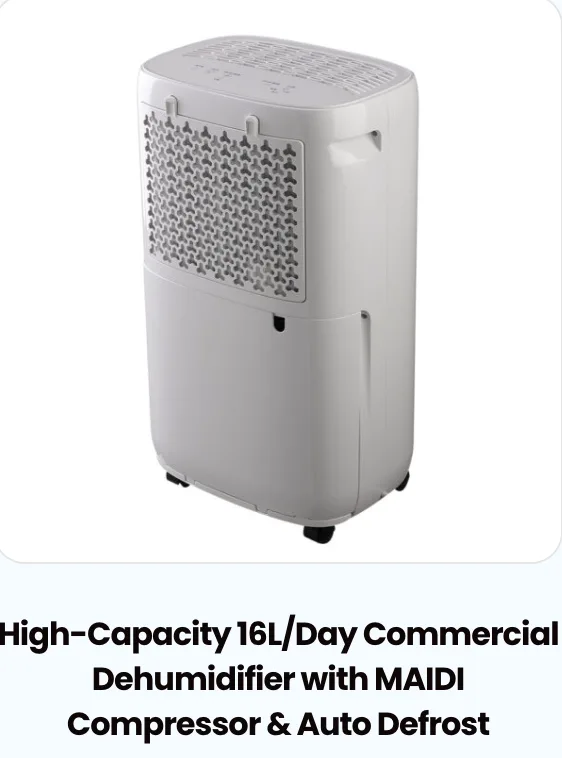
Superior Performance and Coverage
High-Efficiency Dehumidification: Dehumidifies up to 16 liters per day, designed for harsh, high-humidity environments.
Large Area Coverage: Suitable for spaces up to 45 square meters (approximately 484 square feet), perfect for large living rooms, basements, or small to medium-sized commercial spaces.
Powerful Airflow: A circulating airflow of 160 m³/h ensures rapid drying of indoor air.
Core Hardware and Environmentally Friendly Technology: Brand-Name Compressor: Equipped with a MAIDI compressor, ensuring powerful output and long-term stability.
Green Cooling: Uses R290 environmentally friendly refrigerant (65 grams), reducing environmental impact while achieving efficient cooling, meeting modern environmental standards.
Wide Temperature Range Operation: Supports stable operation within a wide temperature range of 5-35°C.
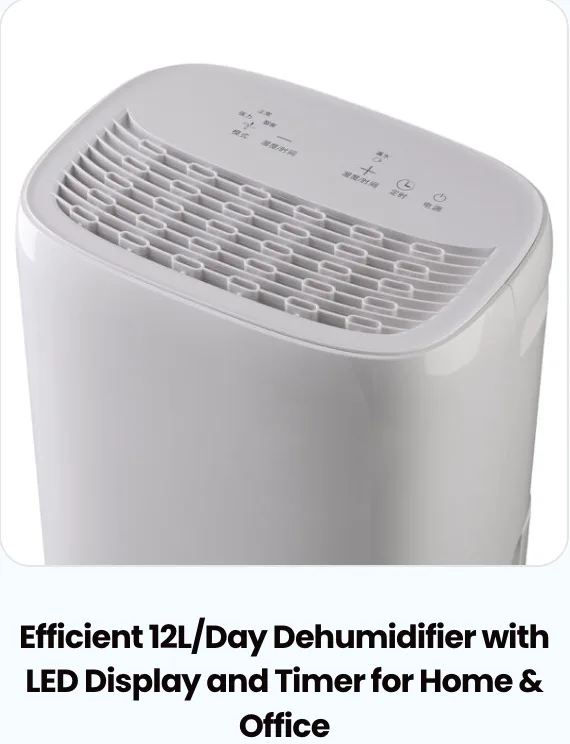
Multi-Specification Series Covering All Scenarios
Customizable Options: Offers three capacity options: 10L, 12L, and 16L, precisely covering different space needs from 25 to 45 square meters.
Tiered Power: Dedicated power configurations for different needs—the 12L model features a powerful ANUODAN compressor, while the 16L model is upgraded to a commercial-grade MAIDI compressor.
Intuitive Control: Equipped with a clear LED digital display, humidity data is readily available.
Flexible Management: Supports 24-hour two-way timer and three preset modes to adapt to various climate conditions.
Two-way Drainage: Built-in 4L large-capacity removable water tank, supports automatic shutdown when full, and provides a continuous drainage interface.
Frequently Asked Questions about Cetus Dehumidifiers
Q1.How Does a Dehumidifier Work?
Dehumidifiers help prevent the growth of mold and fungi—both of which can pose a health threat, especially to sensitive individuals—by removing moisture from the air. They use a fan to blow indoor air through a condenser coil and collect the moisture in a water tank. Dehumidification effectiveness varies between models, so please refer to our dehumidification test results in our review.
Q2.How to Clean a Dehumidifier?
An uncleaned dehumidifier is prone to mold spore growth, which is harmful to allergy sufferers. To prevent mold and other contaminants, Consumer Reports recommends a deep cleaning and disinfection of the empty water tank at least every one to two weeks. Additionally, the filter should be cleaned and dried regularly according to the user manual to maintain dehumidification efficiency. Consumer Reports’ Corente states that if the dehumidifier is placed in a dusty environment, the filter needs to be cleaned more frequently.
Q3.Can Dehumidifiers Lower Air Temperature?
While dehumidifiers can reduce stuffiness indoors by removing moisture from the air, they do not actually lower the room temperature. In fact, it can sometimes have the opposite effect, generating heat, which may slightly raise the room temperature in an enclosed space. However, this temperature increase may be small, and the room will feel cooler and more comfortable because of the reduced humidity.