
Introduction
Drying a room with a dehumidifier can take anywhere from several hours to several days, depending on more than just the unit’s size. Moisture load, room volume, air movement, temperature, starting humidity, and how much water is trapped in materials like drywall or concrete all affect the timeline. This article explains how to estimate drying speed more realistically, why lowering room humidity is not the same as fully drying a space, and what conditions help a dehumidifier work faster. With that context, you can better judge whether a room is drying on schedule or needs changes in equipment, airflow, or operating conditions.
How Fast Can a Commercial Dehumidifier Dry a Room
Determining how quickly a commercial dehumidifier dries a room requires moving beyond subjective observations to evaluate psychrometric data. In commercial and industrial environments, dehumidification is a highly controlled process engineered to mitigate structural damage, prevent microbial growth, and maintain strict environmental compliance. While a residential unit might take 24 to 48 hours to manage ambient moisture in a small bedroom, commercial-grade equipment extracting 150 or more pints per day (PPD) operates on accelerated schedules.
Under optimal conditions, high-capacity commercial dehumidifiers can reduce elevated ambient humidity to a baseline of 45% relative humidity (RH) within 8 to 12 hours. However, structural drying—which involves extracting bound moisture from building materials like drywall, concrete, and framing—extends this timeline significantly, often requiring multiple days of continuous operation.
How should drying time be defined for facility managers
For facility managers, defining drying time strictly by the ambient air temperature and relative humidity is insufficient. True drying time is defined as the duration required for both the air volume and the structural materials within the space to return to their documented equilibrium moisture content (EMC).
If a facility's standard EMC requires wood materials to register below 15% on a moisture meter and ambient air to stabilize at 45% RH, the drying time is the exact number of operational hours required to hit and sustain those specific thresholds without rebound. Stopping the dehumidification process when only the ambient air feels dry often results in secondary moisture blooming, as water trapped in porous materials evaporates back into the room.
What does drying a room mean in measurable terms
In measurable terms, drying a room is quantified using specific humidity metrics, primarily Grains Per Pound (GPP) of dry air and vapor pressure. GPP provides an absolute measurement of moisture mass in the air, independent of temperature fluctuations. For example, a successful drying operation might require driving the room's environment from an initial 90 GPP down to a stable 40 GPP.
Additionally, technicians measure the vapor pressure differential between the wet materials and the surrounding air. A larger differential accelerates evaporation. When a commercial dehumidifier lowers the ambient vapor pressure below the vapor pressure of the damp drywall or concrete, moisture is drawn out of the materials. The room is only considered measurably dry when moisture mapping confirms that the internal moisture content of all structural assemblies matches the pre-loss baseline.
What Affects Dehumidifier Drying Time
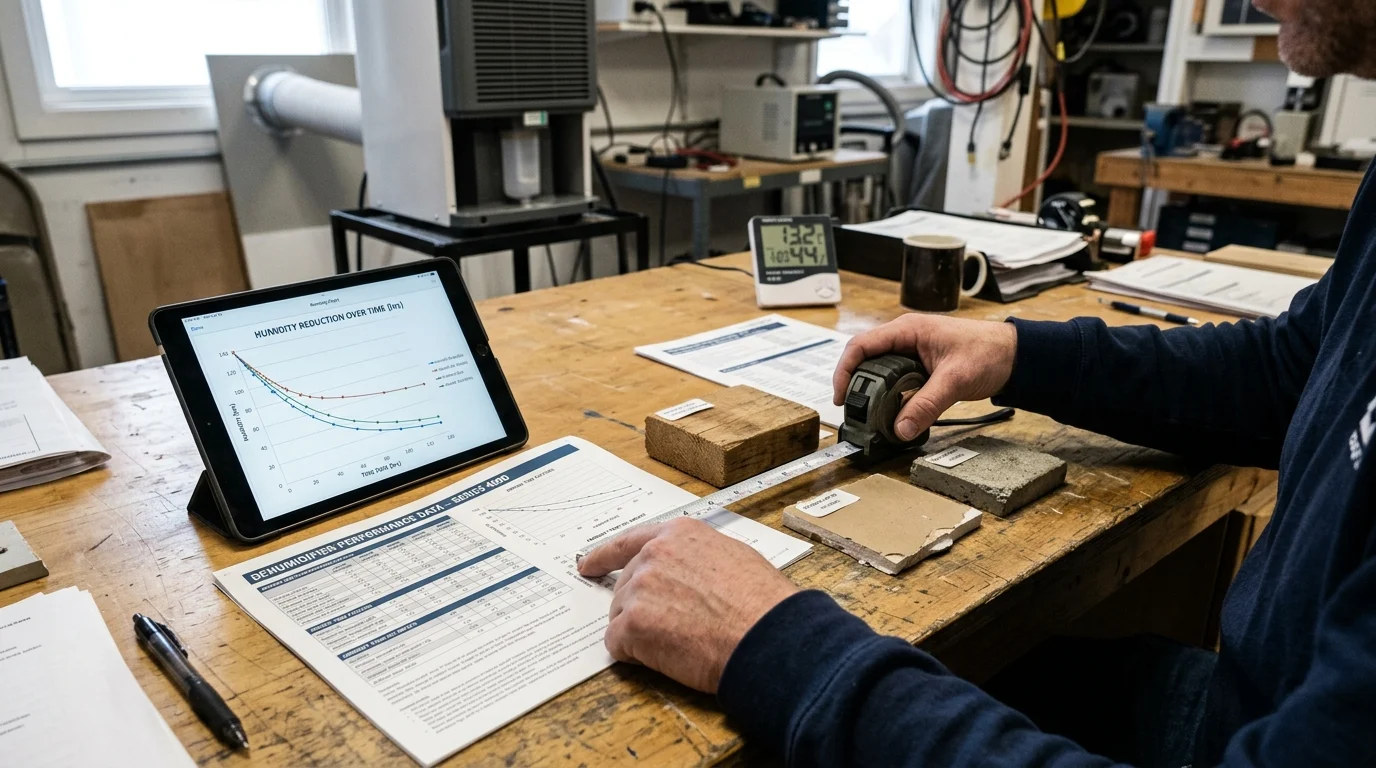
The speed at which a room dries is not a static calculation; it is a dynamic process governed by thermodynamics and psychrometrics. The drying curve is non-linear, meaning moisture removal occurs rapidly in the initial stages when the environment is highly saturated, and slows down significantly as the room approaches its target equilibrium. Operators must account for multiple intersecting variables to accurately forecast drying times.
How do room size, starting humidity, and temperature affect drying speed
The physical dimensions of the space dictate the total volume of air that must be processed. A 5,000-cubic-foot warehouse naturally requires more time to dry than a 1,500-cubic-foot office, assuming identical equipment is used. Starting humidity and temperature are equally critical, as they determine the total water weight suspended in the air.
Warm air holds exponentially more moisture than cold air. A room at 85°F and 80% RH contains a vastly larger mass of water than a room at 65°F and 80% RH. Consequently, higher starting temperatures often yield faster initial extraction rates because the moisture is readily available in the air, provided the dehumidifier is engineered to operate efficiently at elevated temperatures.
How do dehumidifier capacity, airflow, and moisture load affect performance
Dehumidifier capacity, typically measured in Pints Per Day (PPD) under AHAM conditions (80°F at 60% RH), dictates the maximum moisture removal rate. However, capacity must be paired with adequate airflow, measured in Cubic Feet per Minute (CFM). A commercial unit generating 350 CFM will cycle the entire air volume of a 3,500-cubic-foot room every 10 minutes, ensuring the continuous processing of damp air.
The overall moisture load—which categorizes the porosity and saturation level of the materials in the room—serves as the primary bottleneck. Surface water on non-porous epoxy floors evaporates and processes rapidly, whereas deep saturation in concrete slabs or multi-layer wall assemblies creates a high moisture load that limits drying speed entirely by the material's maximum evaporation rate.
Which variables matter most when estimating drying time
While all environmental factors influence the psychrometric process, certain variables exert disproportionate control over the drying timeline. The table below highlights the primary variables and their impact on commercial drying speed.
| Variable | Impact on Drying Speed | Optimal Commercial Range |
|---|---|---|
| Temperature | Dictates air's moisture-holding capacity; higher temps accelerate evaporation. | 70°F – 90°F (for LGR units) |
| Airflow (CFM) | Disrupts the boundary layer of moisture on wet surfaces, pushing water into the air. | 3 to 6 air exchanges per hour |
| Vapor Pressure Differential | The driving force pulling bound moisture out of solid materials. | Maximize gap between material and air |
| Material Permeability | Dense materials (concrete) release water slower than highly porous materials (carpet). | N/A (Fixed by building construction) |
Accurate estimation requires prioritizing the vapor pressure differential and material permeability, as these dictate the physical limits of moisture extraction regardless of how powerful the dehumidifier is.
Typical Drying Times in Commercial Settings
Establishing realistic timelines for commercial drying requires categorizing the nature of the moisture event and the class of equipment deployed. Commercial spaces face varying degrees of moisture challenges, ranging from routine humidity control in manufacturing facilities to emergency recovery following catastrophic water intrusion. Industry-standard drying protocols rely heavily on Low Grain Refrigerant (LGR) and desiccant dehumidifiers to meet strict operational deadlines.
How fast can a refrigerant dehumidifier dry a room
Low Grain Refrigerant (LGR) dehumidifiers are the standard workhorses for commercial structural drying. Unlike conventional units, LGRs feature a double-cooling system that pre-cools the intake air, allowing them to continue extracting moisture even when ambient humidity drops significantly. An LGR unit can efficiently pull ambient moisture down to 34 GPP.
In a standard commercial environment experiencing elevated ambient humidity without standing water, an LGR dehumidifier properly sized for the cubic footage can achieve target humidity levels (e.g., dropping from 70% to 45% RH) within 6 to 12 hours. The high CFM output ensures rapid air turnover, quickly stabilizing the climate.
How long does drying take after water intrusion or high humidity
When a facility experiences physical water intrusion—such as a burst pipe or flooding—the timeline shifts from hours to days. In these scenarios, the dehumidifier is no longer just conditioning the air; it is acting as the engine for structural evaporation. Capillary action draws water deep into drywall, insulation, and framing.
For a Class 2 water intrusion (where water has wicked up walls less than 24 inches), a commercial drying setup typically requires 48 to 72 hours of uninterrupted operation. If the water has saturated dense materials like hardwood flooring or concrete subfloors (Class 4), the drying process frequently extends to 5 to 7 days, necessitating continuous monitoring of the material's internal moisture gradient.
What time ranges are realistic for common room conditions
To provide a baseline for facility planning, realistic timeframes must be mapped to specific environmental conditions and material assemblies.
| Scenario / Room Condition | Primary Equipment Type | Expected Drying Duration |
|---|---|---|
| Ambient Humidity Control (No water damage, lowering RH from 75% to 45%) | Standard Commercial Refrigerant | 8 – 12 Hours |
| Class 1 Water Loss (Minimal absorption, highly porous materials) | LGR Dehumidifier | 24 – 48 Hours |
| Class 2 Water Loss (Significant absorption in drywall/carpet) | LGR Dehumidifier + Air Movers | 48 – 72 Hours |
| Class 4 Water Loss (Deep saturation in concrete, hardwood, or plaster) | Desiccant Dehumidifier | 4 – 7 Days |
These ranges assume that the equipment is appropriately sized for the cubic footage and that optimal operating temperatures are maintained throughout the duration of the project.
How to Speed Up Room Drying
Maximizing the efficiency of a commercial dehumidifier requires a strategic approach to deployment and environmental control. Simply placing a high-capacity unit in the center of a room and turning it on is rarely sufficient for rapid structural drying. Facility managers and restoration professionals must actively manipulate the environment to accelerate evaporation and streamline moisture extraction.
What operating steps improve drying speed
Strategic equipment placement and continuous operation are foundational to rapid drying. Dehumidifiers should be positioned to intake the most saturated air, with their dry exhaust directed toward the wettest areas of the room. Furthermore, operators must optimize condensate management.
Commercial units rely on integrated condensate pumps to purge extracted water. Routing the purge lines efficiently is critical; most internal pumps have a vertical lift limit of 15 to 20 feet. Exceeding this lift capacity can cause the pump to fail or the unit to shut down via its overflow safety switch, halting the drying process entirely. Ensuring uninterrupted power and unobstructed drainage guarantees the unit operates continuously at peak capacity.
How do air movement, room sealing, and drainage support faster drying
Dehumidification alone is inefficient without aggressive air movement. High-velocity axial air movers, which typically produce between 1,000 and 3,000 CFM, are deployed to blow directly across wet surfaces. This mechanical airflow strips away the thin layer of saturated air (the boundary layer) resting on the material, replacing it with the dry air exhausted by the dehumidifier, thereby forcing rapid evaporation.
Simultaneously, the drying environment must be strictly isolated. Sealing the room—often referred to as creating a drying chamber—using 4-mil polyethylene sheeting over doors, windows, and HVAC registers prevents the influx of external humidity. If the room is not sealed, the dehumidifier will waste energy attempting to condition the outside climate, drastically extending the time required to dry the target space.
Which common mistakes slow down drying
The most frequent error in commercial drying is inadequate temperature management. Refrigerant dehumidifiers lose significant extraction efficiency when ambient temperatures fall below 65°F, as the cooling coils risk freezing. Conversely, allowing the room to exceed 95°F can cause the equipment's compressor to overheat and trip thermal overloads.
Another common mistake is an improper ratio of air movers to dehumidifiers. Industry guidelines generally recommend installing one air mover for every 10 to 16 linear feet of wall space. Providing massive airflow without sufficient dehumidification capacity simply aerosolizes the moisture, spiking the room's relative humidity and potentially causing secondary moisture damage to previously dry materials.
How to Choose the Right Dehumidifier for Drying Speed
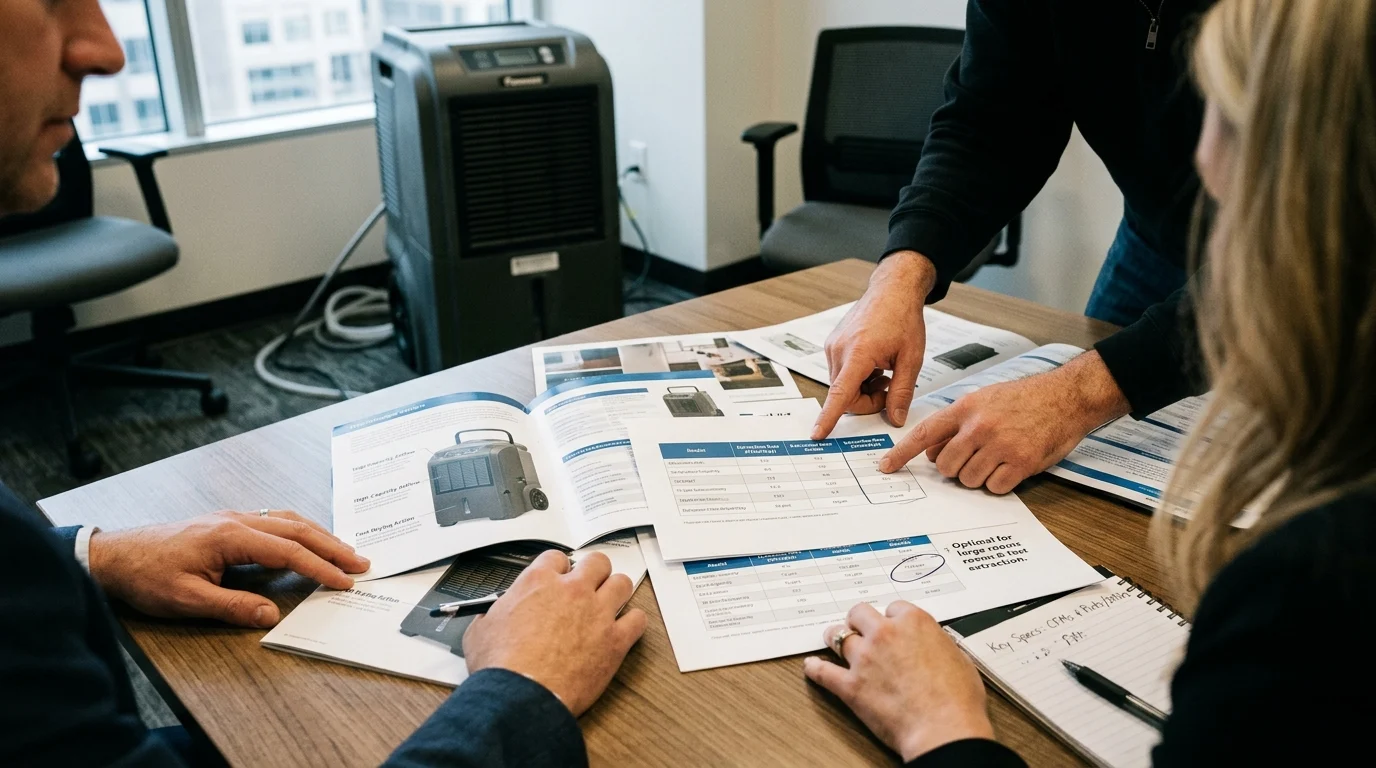
Procuring the correct commercial dehumidifier is a critical factor in achieving aggressive drying timelines. Buyers must look beyond basic marketing claims and evaluate the psychrometric capabilities of the equipment relative to the facility's specific risk profile, volume, and typical environmental conditions. Selecting an underpowered or technologically mismatched unit will inevitably result in prolonged drying times and increased operational costs.
What specifications and monitoring points should buyers review
When evaluating equipment, buyers must scrutinize capacity ratings under standardized conditions. The Association of Home Appliance Manufacturers (AHAM) rating (80°F at 60% RH) provides a reliable baseline, but buyers should also review the unit's performance at saturation (90°F at 90% RH). A machine rated for 130 PPD at AHAM might extract up to 225 PPD at saturation, offering a massive advantage during the initial stages of a flood response.
Onboard telemetry and monitoring points are equally vital. Modern commercial units feature integrated digital hygrometers with ±2% RH accuracy, allowing operators to track temperature, humidity, and job hours directly from the interface. Advanced models offer Bluetooth or Wi-Fi connectivity, enabling remote monitoring of the psychrometric data and sending alerts if the ambient conditions fall outside the optimal drying parameters.
How should Buyers
Key Takeaways
- The most important conclusions and rationale for how quickly dehumidifier
- Specs, compliance, and risk checks worth validating before you commit
- Practical next steps and caveats readers can apply immediately
Frequently Asked Questions
How quickly can a commercial dehumidifier dry a room?
It can often bring high humidity down to about 45% RH in 8–12 hours, but fully drying wet materials usually takes several days of continuous operation.
What determines dehumidifier drying time the most?
Room size, starting humidity, temperature, dehumidifier capacity in PPD, airflow in CFM, and how much moisture is trapped in materials like drywall or concrete.
Does dry air mean the room is fully dry?
No. Air can feel dry while moisture remains inside walls, flooring, or framing. Confirm with moisture meters and stable RH before stopping equipment.
Why does drying slow down after the first few hours?
Dehumidification is fastest when the air is very wet. As RH drops, less free moisture remains in the air, so evaporation from materials becomes slower.
What RH should I target when using a dehumidifier?
For many commercial drying jobs, aim for about 45% RH and keep it stable. Also verify structural materials have returned to their required equilibrium moisture content.