
Introduction: The Dynamic Duo for Indoor Air Quality
Many homeowners and facility managers wonder if they need to choose between a dehumidifier and an air purifier. The short answer is: they are even better when used together. While they perform different functions—one controlling moisture and the other removing pollutants—their goals are perfectly aligned: creating a healthier, more comfortable indoor environment. This section will introduce how these two devices complement each other to tackle everything from persistent musty odors to airborne allergens, providing a “total solution” for air quality.
How They Work in Tandem: Moisture Control vs. Particle Filtration
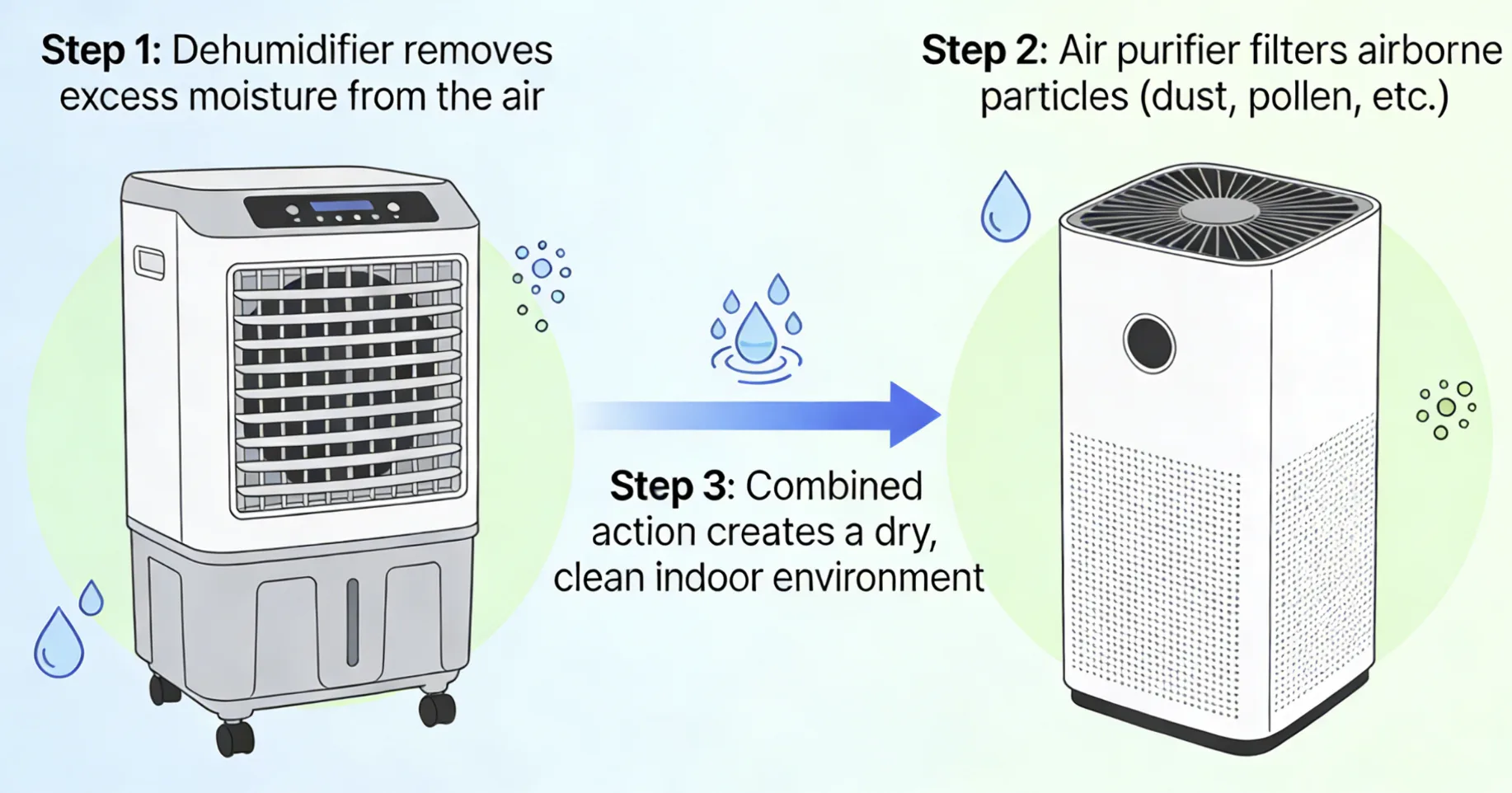
To understand why they work so well together, it’s important to distinguish their roles. A dehumidifier acts as a moisture extractor, pulling excess humidity from the air to prevent the growth of mold, mildew, and dust mites. In contrast, an air purifier is a filtration specialist, using HEPA and carbon filters to trap dust, smoke, pollen, and volatile organic compounds (VOCs). When operated simultaneously, the dehumidifier eliminates the damp conditions where biological pollutants thrive, while the air purifier captures the particles that are already present.
Synergistic Benefits: 1 + 1 > 2
Using both devices creates a synergistic effect that a single unit cannot achieve. For example, by keeping humidity levels below 50%, a dehumidifier prevents mold spores from reproducing. This reduces the “workload” on your air purifier, allowing its filters to last longer and focus on finer pollutants like viruses or smoke. Furthermore, the combination is the ultimate weapon against odors: the dehumidifier stops the damp “basement smell” at the source, while the air purifier’s carbon filter neutralizes any lingering airborne scents.
Best Practices for Simultaneous Operation
To get the most out of this combination, placement and maintenance are key. This section will provide practical tips, such as
Strategic Placement: Why you should place the air purifier near the center of the room and the dehumidifier near moisture sources (like damp walls or basements).
Airflow Management: Keeping doors and windows closed to ensure both machines can efficiently process the room’s air volume.
Maintenance Symmetry: Reminders that as the dehumidifier collects water, the air purifier collects dust; both require regular attention (emptying tanks and changing filters) to maintain peak efficiency.
Cetus Give Your Humidity Solutions
When it comes to high-performance moisture control, Cetus is a leading manufacturer specializing in both home and commercial dehumidification systems. We understand that air quality is a delicate balance, which is why our units are engineered to integrate seamlessly into modern air management strategies. From compact, whisper-quiet models for residential basements to heavy-duty, industrial-grade dehumidifiers for warehouses and commercial facilities, Cetus delivers the power and precision needed to protect your property.
With years of expertise in the HVAC industry, Cetus is committed to innovation, durability, and energy efficiency. Our products are designed to meet the rigorous standards of professional environments while remaining intuitive for everyday use. At Cetus, we don’t just manufacture machines; we provide the foundational climate control solutions that ensure your indoor air remains dry, safe, and comfortable.