
Introduction
Pricing for mini portable dehumidifiers in 2026 is shaped by a mix of normalized supply chains, tighter energy standards, and steady demand for compact moisture-control devices. For buyers, distributors, and retailers, the key question is not just the average unit cost, but how component prices, production scale, noise expectations, and design features affect wholesale and retail ranges. This overview explains what price brackets to expect, which market forces are pushing costs up or down, and how to read pricing differences between basic and higher-spec models. With that context, the following sections break down the 2026 price list and the factors behind it.
2026 Mini Portable Dehumidifier Price Overview
The global market for mini portable dehumidifiers is entering a phase of stabilization as supply chains normalize heading into 2026. For distributors, retailers, and high-volume procurement teams, understanding the current pricing landscape is essential for maintaining competitive margins. Unlike large-scale industrial units, mini dehumidifiers operate in a highly commoditized segment where marginal differences in component costs significantly impact the final wholesale price.
As consumer demand shifts toward energy-efficient and space-saving appliances, manufacturers have optimized production lines to meet strict cost ceilings. The 2026 pricing environment reflects a balance between fluctuating raw material costs, advanced manufacturing efficiencies, and the rising baseline for consumer expectations regarding noise and aesthetics.
Why the 2026 market matters
Driven by an increased focus on indoor air quality and the proliferation of compact living spaces, the 2026 market is projected to see sustained volume growth. Industry forecasts suggest a steady annual growth rate of 6.5% for compact moisture-control appliances. This volume expansion allows tier-one manufacturers to negotiate better rates on bulk components like Peltier modules and ABS plastics.
Furthermore, the 2026 market matters because regulatory standards surrounding electronic waste and energy consumption are tightening globally. Suppliers who have invested in compliant, sustainable manufacturing processes are capturing larger market shares, often at a slight premium, which is reshaping the baseline cost expectations for wholesale buyers.
Key buyer pricing questions
Volume buyers entering the 2026 market are primarily concerned with baseline FOB (Free on Board) pricing, which currently ranges from $12 to $45 per unit depending on the underlying technology and order volume. A central question is how Minimum Order Quantities (MOQs) affect these brackets; a standard MOQ of 1,000 units serves as the baseline for most factory-direct negotiations.
Buyers also frequently question the correlation between extraction capacity and price scaling. Understanding whether a 20% increase in daily moisture removal equates to a proportional increase in unit cost is critical for product line planning. Additionally, procurement teams must factor in the hidden costs of international freight and import duties, which can add between $1.50 and $4.00 per unit depending on the destination port and container utilization.
Product Types and Core Specifications
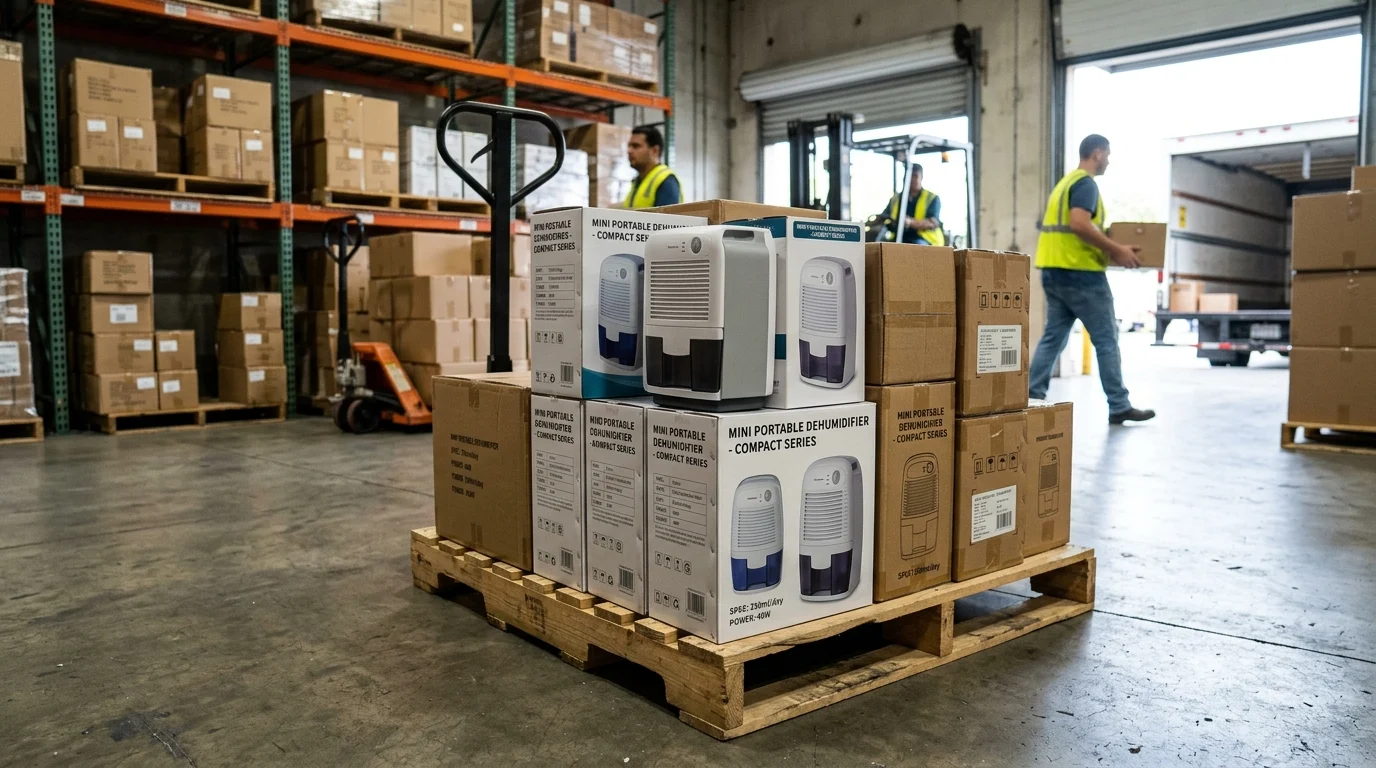
Understanding the technical foundation of these appliances is critical for accurate price evaluation. Mini portable dehumidifiers generally fall into two distinct categories based on their moisture extraction mechanisms. Each technology carries its own manufacturing cost profile, energy footprint, and ideal use case, directly influencing the final wholesale price.
Thermoelectric vs compressor models
The market is heavily divided between thermoelectric (Peltier) models and small-scale compressor units. Peltier models use solid-state technology to condense moisture, making them exceptionally quiet, lightweight, and inexpensive to produce. In contrast, micro-compressor models utilize refrigerant and a mechanical pump, offering vastly superior extraction rates but at a higher manufacturing cost and weight penalty.
| Technology Type | Est. Wholesale Price (FOB) | Power Consumption | Daily Extraction Rate | Ideal Application |
|---|---|---|---|---|
| Thermoelectric (Peltier) | $12.00 – $22.00 | 20W – 45W | 250ml – 750ml | Closets, small bedrooms, RVs |
| Small Compressor | $35.00 – $55.00 | 120W – 180W | 1000ml – 2500ml | Basements, large bedrooms |
For high-volume retail buyers targeting budget-conscious consumers, thermoelectric models remain the dominant choice due to their low barrier to entry and minimal shipping weight.
Key specification ranges
The core specifications that define a unit’s market positioning are its daily extraction rate and its water tank capacity. Standard testing conditions for these metrics are universally set at 30°C (86°F) and 80% Relative Humidity (RH). Under these conditions, baseline mini units extract approximately 250ml to 300ml per day, while premium compact models can reach up to 1000ml.
Water tank capacities typically scale with extraction rates, ranging from 500ml in entry-level models to 2000ml in mid-tier variants. For a comprehensive look at modern specifications and how they align with current market offerings, reviewing the latest mini portable dehumidifiers provides a reliable benchmark for industry standards. Units with auto-shutoff sensors and continuous drainage hose options command a $2.00 to $4.00 premium on the wholesale price.
Main Cost Drivers
Beyond the core technology type, several variable factors dictate the final unit price of a mini portable dehumidifier. Manufacturers calculate quotes based on a complex matrix of component costs, production run times, and client-specific customization requirements. Isolating these cost drivers is essential for effective negotiation.
Capacity, tank size, noise, and power use
Upgrading the physical dimensions of the unit to accommodate a larger water tank naturally increases the cost of tooling and plastic injection molding. Moving from a standard 500ml tank to a 1500ml tank typically adds $1.50 to $3.00 to the manufacturing cost, not including the proportional increase in shipping volume.
Noise reduction and power efficiency are also significant price drivers. Achieving a sub-30dB noise level—highly desirable for bedroom applications—requires premium brushless DC fans and superior acoustic dampening materials. These upgraded components, alongside optimized PCB (Printed Circuit Board) designs for better energy efficiency, can increase the base FOB price by 10% to 15%.
Materials, branding, MOQ, and warranty
The quality of housing materials heavily influences both cost and perceived product value. Standard units utilize virgin ABS plastic, but transitioning to UV-resistant or fire-retardant plastics for enhanced safety compliance will elevate material costs. Furthermore, OEM branding requirements, such as custom Pantone color matching and premium retail packaging, require additional setup fees.
Order volume remains the most powerful lever in pricing. Stepping from an MOQ of 500 units to a volume order of 5,000 units can swing unit prices by 15% to 20% due to economies of scale. Finally, the length and comprehensiveness of the manufacturer’s warranty impact the quote; extending a standard 1-year warranty to a 2-year warranty requires the supplier to allocate a higher percentage of the contract value to potential RMA (Return Merchandise Authorization) reserves, typically increasing the unit price by $0.50 to $1.20.
Sourcing, Compliance, and Logistics
Securing a favorable unit price is only part of the procurement process; navigating the complexities of compliance and international logistics is equally critical. In 2026, stringent regulatory environments and fluctuating freight rates require buyers to take a holistic approach to their sourcing strategy.
Certifications and regional compliance
Electronic appliances must meet rigorous regional safety and environmental standards before entering consumer markets. For the European market, CE and RoHS certifications are mandatory, while North American markets require FCC compliance and highly value UL or ETL safety listings. Purchasing uncertified units presents a severe liability and risk of customs seizure.
If a buyer requests a heavily customized design that falls outside the factory’s pre-certified white-label models, the buyer must shoulder the NRE (Non-Recurring Engineering) costs for new compliance testing. Depending on the target markets and required laboratory hours, these certification processes can add between $2,500 and $6,000 in upfront costs, which must be amortized over the total order volume.
Factory selection, samples, shipping, and support
Selecting a factory with a proven track record of quality control and on-time delivery is paramount. Standard production lead times for mini dehumidifiers range from 30 to 45 days after sample approval and deposit receipt. Expedited timelines may incur rush charges or result in compromised QA protocols.
Logistics planning requires accurate volumetric calculations to maximize container space. A standard 40HQ (High Cube) shipping container can hold approximately 4,500 to 6,500 mini dehumidifiers, depending on the retail packaging dimensions. Efficient palletization reduces the per-unit freight cost significantly. Connecting with a reliable manufacturing partner via their contact portal can streamline logistics planning and ensure that packaging dimensions are optimized for current freight standards.
How to Compare Quotes and Make Buying Decisions
When evaluating the 2026 price list, procurement teams must look beyond the lowest initial unit cost. A structured approach to comparing quotes ensures that buyers are comparing equivalent products and services, safeguarding against hidden costs and downstream quality issues.
Steps for quote comparison and negotiation
Standardizing the Request for Quotation (RFQ) is the first step in effective comparison. Buyers should mandate that all suppliers quote based on identical specifications, including extraction rate, tank size, noise level, and Incoterms (e.g., FOB Shenzhen).
| Evaluation Criteria | Supplier A (Budget) | Supplier B (Premium) | Impact on Decision |
|---|---|---|---|
| Base Price (1k MOQ) | $13.50 | $15.20 | $1.70 variance per unit |
| Defect Rate (AQL) | 2.5 Major / 4.0 Minor | 1.5 Major / 4.0 Minor | Lower defect rate saves post-sale costs |
| Lead Time | 45 Days | 30 Days | Faster turnaround improves cash flow |
| Certifications | CE, RoHS | CE, RoHS, ETL | ETL allows entry into US major retail |
Negotiations should leverage the data from these matrices. A common standard for quality control is an Acceptable Quality Limit (AQL) of 1.5 for major defects. If a supplier offers a low price but refuses to accept third-party inspections under this AQL standard, the risk of receiving unsellable inventory negates the upfront savings.
Final decision criteria
The final sourcing decision should balance capital expenditure with long-term product reliability and brand reputation. A unit that costs $1.50 more but features a highly reliable brushless motor and superior plastic finishing will yield higher consumer reviews and lower return rates.
Furthermore, assessing the supplier’s corporate stability and post-sales support is vital. Reviewing a manufacturer’s history and infrastructure, often detailed on their about page, provides insight into their capacity to handle reorders and honor warranty claims. Ultimately, the most cost-effective 2026 pricing strategy relies on forging partnerships with transparent, compliant, and communicatively responsive manufacturers.
Further reading:
Key Takeaways
- The most important conclusions and rationale for Mini Portable Dehumidifiers
- Specs, compliance, and risk checks worth validating before you commit
- Practical next steps and caveats readers can apply immediately
Frequently Asked Questions
What is the typical 2026 FOB price for mini portable dehumidifiers?
Most factory-direct mini portable dehumidifiers range from about $12 to $45 per unit FOB, depending on technology, specs, and order volume.
How does MOQ affect mini dehumidifier pricing in 2026?
A common MOQ is 1,000 units. Higher volumes usually lower per-unit pricing and improve factory negotiation terms on features and packaging.
Which mini portable dehumidifier type is usually cheaper?
Thermoelectric (Peltier) models are usually cheaper, typically around $12 to $22 FOB, and suit closets, RVs, and small bedrooms.
What extra costs should buyers add beyond the unit price?
Plan for freight, import duties, and possible feature premiums. These often add about $1.50 to $4.00 per unit, plus $2 to $4 for upgrades like auto-shutoff or drainage.
Where can buyers compare mini portable dehumidifier options from Cetusdry?
Buyers can review current compact dehumidifier models and specifications on Cetusdry’s product pages at cetusdry.com/products for a practical pricing benchmark.