
Introduction
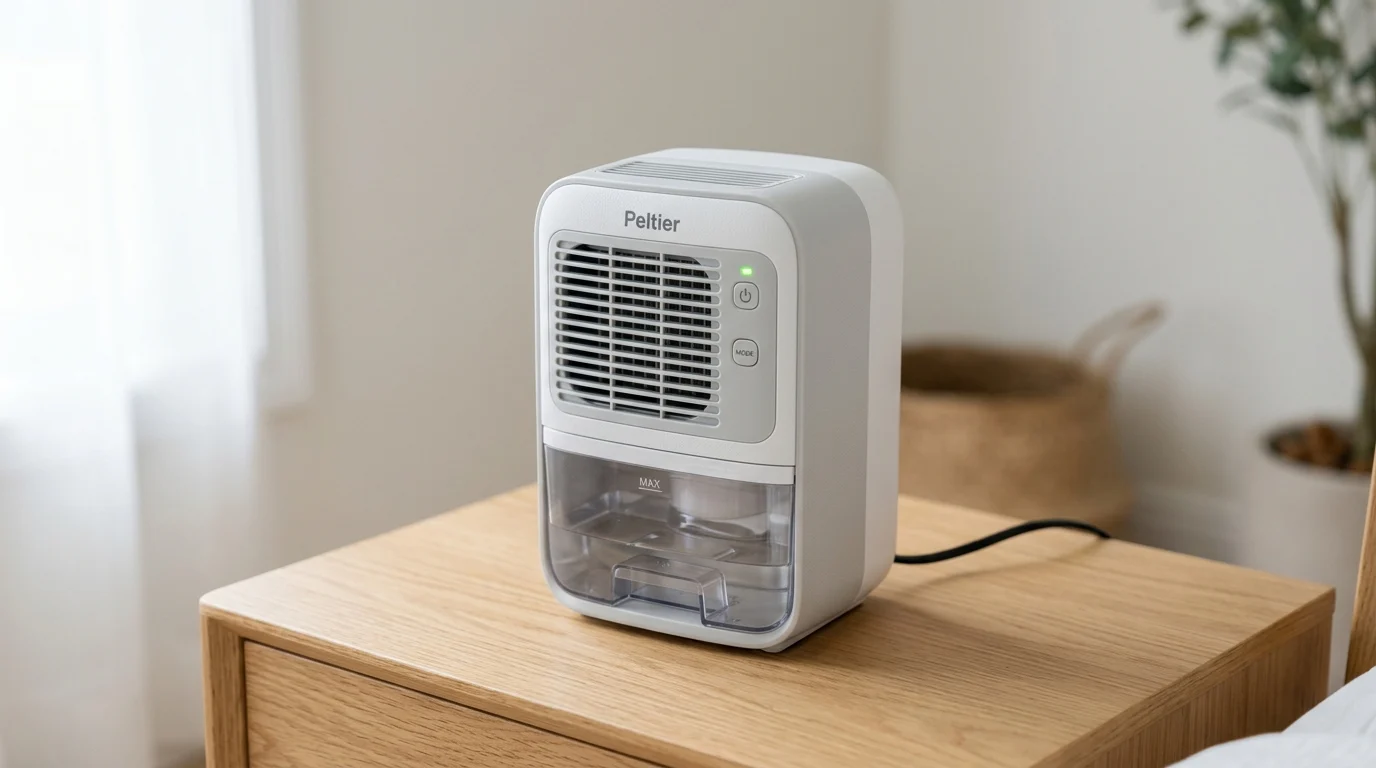
Peltier dehumidifiers use thermoelectric cooling to pull moisture from the air, making them a compact alternative to compressor-based units in small, enclosed spaces. They are best suited to light-duty humidity control where low noise, minimal vibration, and a small footprint matter more than high water-removal capacity. This article explains how a Peltier dehumidifier works, where it performs well, and where its limits become clear. By the end, you’ll be able to judge whether one is a practical choice for spaces like closets, bedrooms, cabinets, RVs, or equipment enclosures—or whether a larger conventional dehumidifier is the better fit.
Why peltier dehumidifiers matter today
The global climate control sector has seen a pronounced shift toward highly localized, micro-environmental humidity management. While industrial and whole-room applications rely heavily on traditional compressor-driven systems, the emergence of moisture-sensitive electronics, specialized storage, and compact living spaces has elevated the role of solid-state dehumidification.
Peltier dehumidifiers, utilizing thermoelectric technology rather than refrigerants, have become a cornerstone in this specialized segment. As spatial constraints tighten and the demand for low-maintenance, vibration-free climate control increases, understanding the operational boundaries and market positioning of these devices is critical for procurement professionals and system integrators.
Changing demand for compact humidity control
The necessity for compact humidity control stems from the proliferation of precision instruments, optical gear, and high-value archival storage. These applications demand strict moisture regulation without the mechanical vibration or spatial footprint of conventional units.
Peltier dehumidifiers operate seamlessly within tight volumetric constraints—often engineered for enclosures under 5 cubic meters—providing active moisture extraction while maintaining acoustic emissions strictly below the 35 dB threshold. This silent, steady-state operation is increasingly demanded in residential micro-spaces, such as wardrobes and recreational vehicles, as well as in commercial applications like server racks and laboratory cabinets.
Where they fit in the dehumidifier market
Within the broader dehumidifier market, Peltier units occupy a distinct sub-2-liter capacity tier. They are not designed to remediate flooded basements or manage warehouse-level humidity; rather, they serve as precision tools for targeted moisture control.
From a manufacturing and procurement standpoint, these units represent a highly scalable solution. Wholesale pricing typically ranges from $20 to $65 per unit depending on the extraction capacity and smart features. Original Equipment Manufacturers (OEMs) generally require Minimum Order Quantities (MOQs) between 500 and 1,000 units for custom branding or specific voltage adaptations, making them an accessible entry point for brands expanding their environmental control portfolios.
What a peltier dehumidifier is and how it works
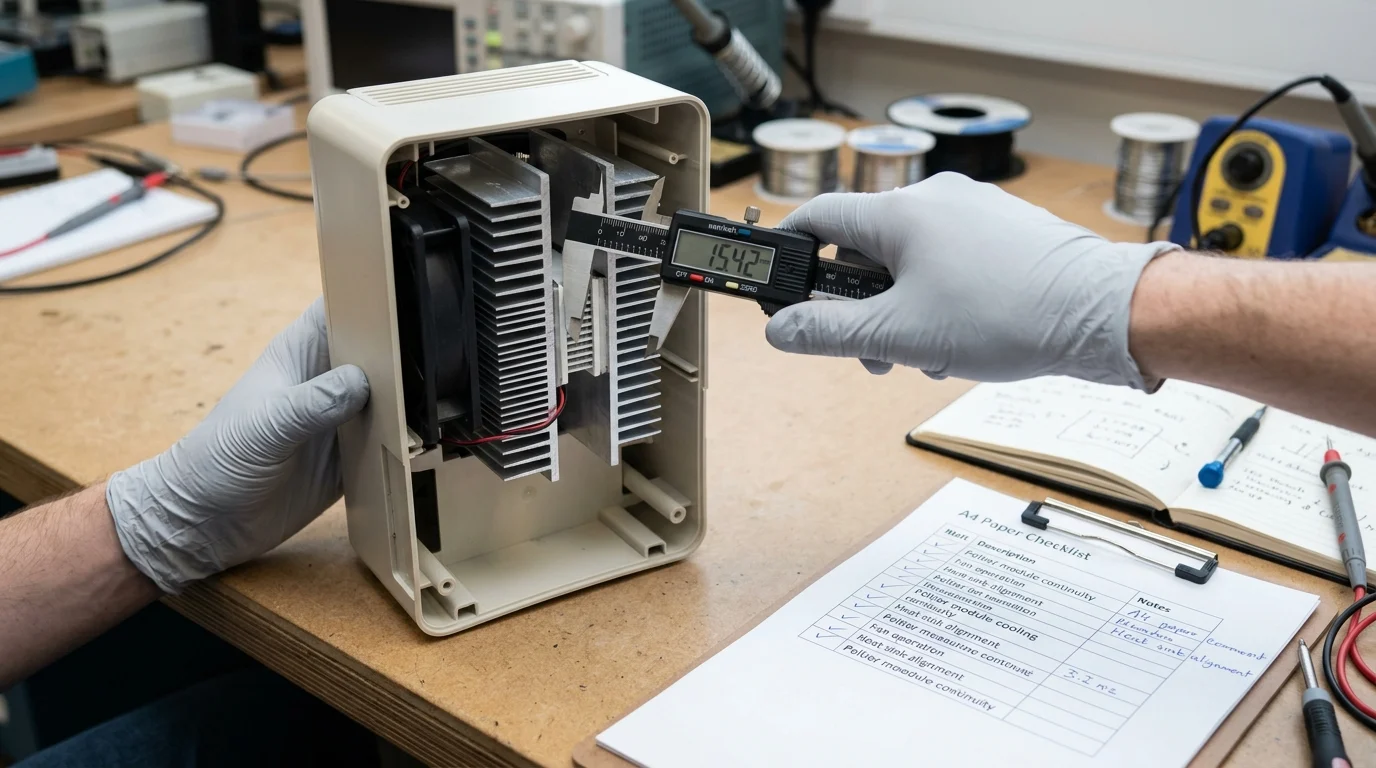
At the core of a Peltier dehumidifier is thermoelectric technology, a solid-state method of heat transfer that eliminates the need for volatile chemical refrigerants, bulky compressors, and complex evaporator coils. By leveraging the Peltier effect, these devices achieve localized cooling through electrical currents, offering a simplified, highly reliable mechanism for moisture extraction.
Core components and thermoelectric operation
The system relies fundamentally on a Peltier module, typically constructed from bismuth telluride semiconductor p-n junctions sandwiched between two thermally conductive ceramic plates. When direct current (DC) passes through the module, heat is absorbed on one side and dissipated on the other.
This thermoelectric phenomenon creates a stark thermal differential, often achieving a Delta T (ΔT) of 40°C to 70°C across the module's surfaces. An integrated low-voltage DC fan draws ambient air over an aluminum heat sink attached to the cold side, dropping the air temperature below its dew point. Condensation forms on the fins and drips into a collection reservoir. The cooled, dehumidified air then passes over the hot-side heat sink, recovering thermal energy before being exhausted back into the environment as warm, dry air.
Conditions that affect water removal and energy use
The efficacy of thermoelectric extraction is highly contingent upon ambient thermodynamics. Standardized testing and capacity ratings for these units typically occur under baseline conditions of 30°C and 80% Relative Humidity (RH). Under these optimal parameters, a standard 40W Peltier unit can extract approximately 250ml to 500ml of water per 24-hour cycle.
However, extraction rates decay exponentially as ambient temperatures drop. Below 15°C, the cold heat sink is prone to freezing, and the absolute moisture content in the air is often too low for efficient solid-state extraction. Energy consumption remains relatively flat regardless of extraction efficiency, typically drawing between 20W and 60W continuously. This makes them highly energy-efficient for continuous operation in warm, humid micro-climates (averaging 0.05 kWh to 0.15 kWh per day), but inefficient in cold environments where compressor or desiccant technologies perform better.
Peltier vs compressor and desiccant dehumidifiers
Selecting the appropriate dehumidification technology requires a rigorous assessment of operational parameters, spatial constraints, and lifecycle costs. Peltier systems must be evaluated directly against compressor and desiccant alternatives to determine long-term viability in specific commercial and consumer applications.
Key comparison criteria
The fundamental differences between the three primary dehumidification technologies dictate their application suitability. Compressor units utilize refrigerants and mechanical compression to cool coils, offering massive capacity but high noise and weight. Desiccant units use moisture-absorbing materials (like silica gel) and a heating element to regenerate the material, performing exceptionally well in freezing temperatures. Peltier units offer a middle ground for micro-spaces, prioritizing solid-state reliability and minimal acoustic output.
| Feature | Peltier (Thermoelectric) | Compressor (Refrigerant) | Desiccant (Adsorption) |
|---|---|---|---|
| Extraction Capacity | 0.2 to 1.0 Liters/day | 10 to 150+ Liters/day | 5 to 50+ Liters/day |
| Optimal Temp Range | 15°C to 35°C | 5°C to 35°C | 1°C to 35°C |
| Power Consumption | 20W to 60W | 200W to 800W+ | 300W to 700W+ |
| Acoustic Output | 25 dB to 40 dB | 45 dB to 65 dB | 35 dB to 50 dB |
| Weight Profile | 1 kg to 3 kg | 12 kg to 40 kg | 6 kg to 15 kg |
When a peltier unit is the better choice
Peltier systems represent the optimal engineering choice when spatial volume is strictly limited to under 10 square meters (approximately 100 square feet) and ambient temperatures consistently remain above 15°C. They are the definitive solution for zero-vibration requirements, a critical specification for enclosures housing sensitive optical equipment, firearms safes preventing metallurgical corrosion, and specialized archival storage boxes.
Furthermore, in environments where the electrical infrastructure is constrained, Peltier units excel. A continuous power draw of 500W from a compressor unit could overload localized circuitry or drain off-grid solar-inverter setups found in marine cabins or recreational vehicles. In these scenarios, the nominal 20W to 60W draw of a Peltier unit provides vital moisture mitigation without threatening the primary power infrastructure, making it the superior choice for off-grid or low-amperage deployments.
How to choose the right peltier dehumidifier
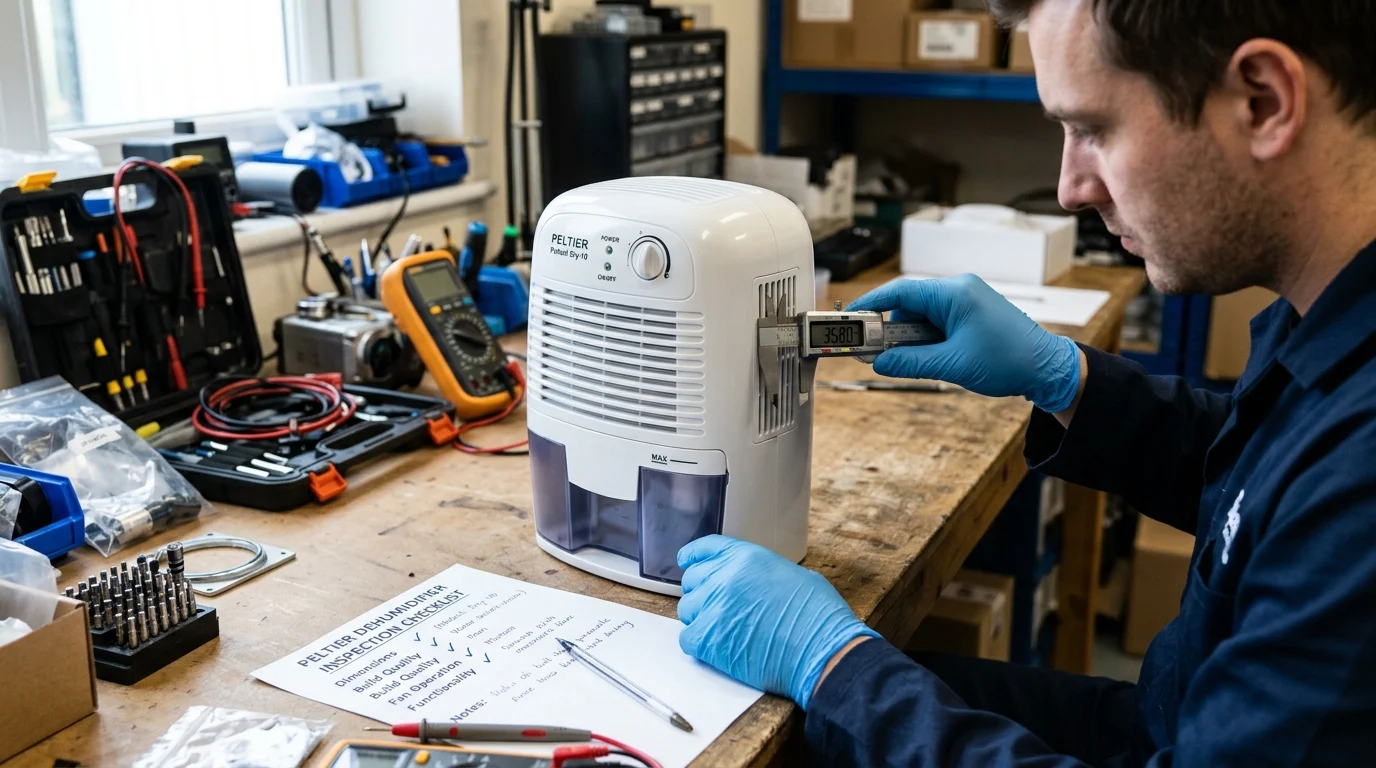
Procuring the correct thermoelectric dehumidifier for commercial, industrial, or high-end residential integration involves moving beyond basic capacity claims. Buyers must evaluate component longevity, electronic safety standards, and specific integration requirements to ensure reliable, autonomous operation.
How to assess fit for your application
The initial assessment requires calculating the exact volumetric footprint of the target enclosure and estimating the moisture ingress rate. For applications like storing sensitive printed circuit boards (PCBs) or camera lenses, the target Relative Humidity (RH) must strictly remain between 40% and 50% to prevent fungal growth and oxidation.
Engineers must verify that the chosen unit's extraction curve at the specific ambient temperature of the enclosure exceeds the natural moisture ingress rate. For example, a 5-cubic-meter sealed cabinet in a 25°C environment may only require an extraction rate of 150ml per day to maintain a 45% RH, making a standard 300ml/day Peltier unit perfectly sized to achieve and hold the target RH rather than running continuously with no net reduction.
Key selection factors
Beyond the standard extraction metric, buyers must evaluate water management systems. Reservoir capacities typically range from 500ml for ultra-compact units to 2,000ml for larger thermoelectric models. For unmonitored deployments, a unit must feature a robust auto-shutoff mechanism.
This is usually achieved via a magnetic float switch or an optical sensor that interrupts the DC power to the Peltier module when the tank reaches roughly 90% capacity, preventing overflow. Alternatively, continuous drainage ports—typically requiring an 8mm to 12mm internal diameter hose—are mandatory for permanent, inaccessible installations, eliminating the labor costs associated with manual tank emptying.
Specification and compliance checks
Enterprise procurement mandates strict adherence to international electrical and material safety standards. Because these units operate continuously in enclosed spaces, power supply stability and thermal runaway protection are paramount.
| Specification / Standard | Relevance to Peltier Dehumidifiers | Target Benchmark |
|---|---|---|
| MTBF (Mean Time Between Failures) | Determines the lifespan of the DC fan and Peltier module. | > 40,000 hours |
| CE / FCC Certification | Ensures electromagnetic compatibility and basic safety for EU/US markets. | Mandatory for import |
| RoHS Compliance | Restricts hazardous materials in semiconductor and PCB manufacturing. | Mandatory for global distribution |
| UL / ETL Listing (Power Supply) | Validates the safety of the AC-to-DC power adapter against fire hazards. | Required for commercial use |
Selecting a unit with a verified MTBF exceeding 40,000 hours ensures roughly 4.5 years of continuous, failure-free operation. Furthermore, verifying that the external AC-to-DC power adapter carries a UL or ETL listing is critical, as the power supply is statistically the most common point of thermal failure in low-cost thermoelectric devices. By validating these specifications, integrators maximize the return on investment and safety of their solid-state climate control infrastructure.
Key Takeaways
- The most important conclusions and rationale for peltier dehumidifier
- Specs, compliance, and risk checks worth validating before you commit
- Practical next steps and caveats readers can apply immediately
Frequently Asked Questions
What is a Peltier dehumidifier?
A Peltier dehumidifier uses thermoelectric cooling to condense moisture from air. It has no compressor or refrigerant, making it compact, quiet, and suited to small spaces.
When should I use a Peltier dehumidifier?
Use one in warm, humid, enclosed spaces like wardrobes, RVs, cabinets, or server racks, especially when low noise and small size matter more than high water removal.
How much water can a Peltier dehumidifier remove per day?
Most small units remove about 250–500 ml per 24 hours at roughly 30°C and 80% RH. Performance drops a lot in cooler or drier conditions.
Are Peltier dehumidifiers energy efficient?
They are efficient for targeted, continuous use in micro-spaces, typically drawing 20–60W. They are less efficient than other types when used in cold rooms or large areas.
When is a compressor or desiccant dehumidifier better?
Choose a compressor model for larger, warmer rooms and higher extraction. Choose a desiccant model for colder spaces below about 15°C, where Peltier units may struggle or freeze.