
Introduction
Commercial dehumidifiers often run in basements, warehouses, job sites, and other spaces where coil temperatures can drop low enough for frost to form. When that happens, airflow and heat transfer decline, moisture removal slows, and internal components face added strain. The auto-defrost function is designed to detect these conditions and temporarily clear ice before performance falls too far. In the sections that follow, you’ll see how auto-defrost works, why it matters even above freezing ambient temperatures, and what its operation reveals about efficiency, reliability, and proper equipment selection.
Why Auto-Defrost Matters in Commercial Dehumidifiers
The auto-defrost function is a non-negotiable component in commercial dehumidification systems. Operating in unconditioned spaces or specialized industrial environments exposes equipment to thermal variables that rapidly induce coil icing. Without active frost mitigation, a dehumidifier can experience up to a 60% degradation in moisture extraction efficiency within a single operational cycle, ultimately leading to catastrophic compressor failure via liquid slugging or severe thermal overload.
How auto-defrost protects moisture removal performance
The thermodynamics of vapor-compression dehumidification rely on maintaining precise temperature differentials. When evaporator coil temperatures drop below the localized dew point and the freezing point of water, condensation transitions directly into frost. Ice acts as an exceptional thermal insulator, possessing a thermal conductivity of approximately 2.2 W/m·K, which is drastically lower than the copper or aluminum of the heat exchange coils. This insulating layer blocks thermal transfer, while the physical accumulation restricts volumetric airflow, frequently reducing cubic feet per minute (CFM) throughput by up to 40%. The auto-defrost function intervenes to melt this accumulation, restoring the optimal heat exchange coefficient and ensuring the unit continues to extract moisture at its rated capacity.
Which operating conditions require auto-defrost
Frost formation is not exclusive to freezing environments. Commercial dehumidifiers require robust auto-defrost capabilities whenever ambient temperatures fall below 65°F (18.3°C) coupled with high relative humidity. Environments such as subterranean crawlspaces, unconditioned warehouses, and cold storage facilities frequently operate in the 33°F to 55°F (0.5°C to 12.8°C) range. In these conditions, the refrigerant temperature inside the evaporator easily drops below 32°F (0°C). Without an automated defrost cycle, continuous operation in these microclimates guarantees rapid, compounding ice accumulation that paralyzes moisture removal operations and threatens the mechanical integrity of the refrigeration circuit.
How Auto-Defrost Works in Real Conditions
Understanding the operational mechanics of the auto-defrost function requires examining the interplay between thermodynamics, sensor technology, and control logic. The effectiveness of a dehumidifier in low-temperature environments hinges entirely on how rapidly and accurately the system identifies and eliminates frost without compromising the overall moisture extraction timeline.
What causes frost on evaporator coils
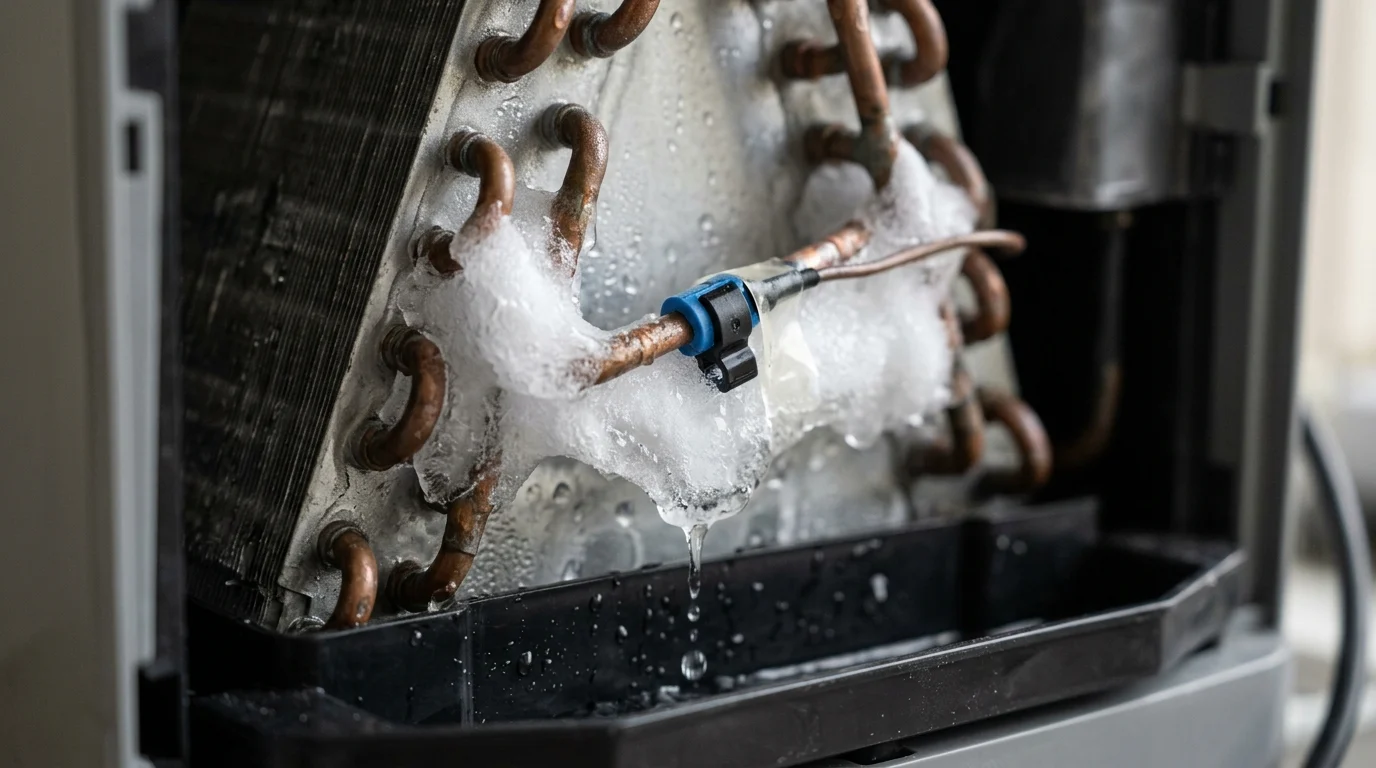
Frost on evaporator coils is a direct consequence of latent heat extraction. As ambient air is drawn across the evaporator, the refrigerant absorbs both sensible and latent heat. If the evaporator surface temperature drops below the localized dew point and below 32°F (0°C), the phase change bypasses the liquid state, causing water vapor to desublimate directly into ice. High moisture loads combined with low ambient temperatures accelerate this desublimation, creating a thick, restrictive layer of rime ice across the finned surfaces that chokes the aerodynamic pathways.
How sensor-based, timer-based, and adaptive defrost differ
Dehumidifier manufacturers deploy various logic systems to manage this icing phenomenon, each offering distinct advantages based on the operating environment.
| Defrost Logic Type | Trigger Mechanism | Typical Application | Efficiency Impact |
|---|---|---|---|
| Timer-Based | Fixed intervals (e.g., every 45 mins) | Residential / Light Commercial | Low (often runs when unnecessary) |
| Sensor-Based | NTC thermistor detects coil temp ≤ 30°F | Heavy Commercial / Industrial | High (runs only when ice is present) |
| Adaptive | Microprocessor analyzes cycle history | Precision Agriculture / Pharma | Maximum (optimizes energy & extraction) |
Timer-based systems operate blindly, halting the compressor at scheduled intervals regardless of actual frost accumulation. Sensor-based systems utilize Negative Temperature Coefficient (NTC) thermistors to measure coil temperatures, typically initiating defrost only when surface temperatures register below 30°F (-1.1°C). Adaptive systems represent the apex of defrost logic, utilizing microprocessors to track ambient temperature, humidity, and historical defrost durations to predict and preemptively manage frost, thereby minimizing unnecessary compressor downtime.
Which performance indicators show defrost effectiveness
The primary performance indicator of a successful auto-defrost function is the recovery time—the duration required to completely clear the coils and resume active moisture extraction. Standard fan-only defrost sequences may require 10 to 15 minutes to clear a moderately iced coil. Conversely, advanced active defrost mechanisms can achieve total clearance in 3 to 5 minutes. This drastic reduction in downtime directly impacts the cumulative moisture extraction capacity, often yielding up to a 15% increase in total daily pints-per-day (PPD) removal during sustained cold-weather operation.
How to Compare Auto-Defrost Designs
Specifying commercial dehumidification equipment requires a thorough evaluation of the internal architecture governing the auto-defrost function. The mechanical design, component ratings, and overall build quality dictate whether a unit will survive continuous duty cycles in harsh, low-temperature environments or succumb to premature mechanical failure.
Which design features separate dehumidifier models
The most significant architectural divergence in auto-defrost designs is the choice between fan-only defrost and Hot Gas Bypass (HGV) systems. Fan-only systems halt the compressor and leave the blower running, relying on the ambient air to melt the ice. This method becomes practically obsolete when ambient temperatures drop below 41°F (5°C). In contrast, an HGV auto-defrost function utilizes a solenoid valve to redirect high-temperature, high-pressure refrigerant gas (typically ranging from 120°F to 140°F) directly from the compressor discharge into the evaporator coil. This internal heating mechanism actively melts frost from the inside out, operating effectively regardless of frigid ambient air temperatures.
Which specifications reveal low-temperature performance
Procurement engineers must scrutinize the Low-Temperature Rating (LST) and operating envelopes provided by manufacturers to gauge true performance. A standard commercial unit might advertise an operating range starting at 41°F (5°C), indicating a reliance on passive fan defrost. Industrial units equipped with HGV and adaptive logic will explicitly state an operational capability down to 33°F (0.5°C). Furthermore, specifications detailing the defrost cycle frequency and duration at specific ASHRAE testing conditions (e.g., 55°F at 60% RH) provide empirical baseline data on how the unit handles sustained low-temperature moisture loads.
How build quality affects defrost reliability
The reliability of the auto-defrost function is intrinsically linked to component durability. In HGV systems, the bypass solenoid valve is subjected to immense thermal and pressure cycling; commercial-grade valves must be rated for over 100,000 actuation cycles to ensure lifecycle longevity. Additionally, the printed circuit boards (PCBs) managing the defrost logic must feature robust conformal coating. Because these sensors and boards operate continuously in microclimates where relative humidity frequently exceeds 80%, protection against condensation and galvanic corrosion is paramount for preventing sensor drift and logic failures.
Selection, Installation, and Maintenance Best Practices
Even the most sophisticated auto-defrost function cannot overcome poor deployment strategies. Proper capacity sizing, strategic installation, and rigorous maintenance protocols are essential to keep the dehumidifier operating within its designed thermal envelope, thereby minimizing unnecessary and energy-draining defrost cycles.
How to match auto-defrost capability to the site
Aligning the auto-defrost capability with the specific thermal dynamics of the site is the first step in successful deployment. A facility maintaining an average ambient temperature of 45°F (7.2°C) necessitates a unit with a hot gas bypass system; deploying a fan-only defrost model in this environment guarantees continuous icing and nominal moisture extraction. Additionally, engineers must ensure the volumetric airflow matches the spatial requirements. A general benchmark requires 3 to 4 air changes per hour (ACH). If a unit is undersized, it will run continuously to meet the humidity setpoint, driving the evaporator temperatures lower over extended periods and artificially inducing the need for constant defrosting.
Which installation and maintenance practices reduce icing
Preventative maintenance directly impacts the frequency and severity of coil icing. Airflow restriction is the primary non-thermal catalyst for frost accumulation. If a standard MERV-8 filter becomes saturated with particulate matter, it can reduce volumetric airflow by upwards of 25%. This reduction starves the evaporator of sensible heat, causing localized freezing even in moderate ambient temperatures. Furthermore, evaporator coils require annual chemical cleaning to preserve their hydrophilic coatings. A compromised coating causes condensation to bead and freeze rapidly, whereas a maintained hydrophilic surface allows water to sheet off efficiently, reducing the baseline burden on the auto-defrost function.
Procurement Criteria for Auto-Defrost Performance
Evaluating the financial and operational implications of auto-defrost technologies is critical for accurate lifecycle cost analysis. Procurement professionals must balance initial capital expenditures against long-term reliability, energy efficiency, and operational continuity.
When premium auto-defrost is worth the higher cost
The decision to invest in premium auto-defrost technology, such as Hot Gas Bypass and adaptive microprocessor controls, fundamentally alters the Total Cost of Ownership (TCO) equation.
| Defrost Technology | Est. CAPEX Premium | Defrost Cycle Time | Risk of Compressor Slugging | Energy Efficiency in Cold (<45°F) |
|---|---|---|---|---|
| Passive (Fan-Only) | Base Cost | 10-20 mins | Moderate to High | Poor |
| Active (HGV) | +$200 – $400 | 3-5 mins | Extremely Low | Excellent |
While an active HGV auto-defrost function introduces a $200 to $400 premium on the initial Capital Expenditure (CAPEX), the return on investment is realized rapidly in unconditioned environments. The drastic reduction in defrost cycle times means the compressor spends more time actively extracting moisture, maximizing the energy consumed per pint of water removed (L/kWh) and preventing costly operational bottlenecks.
How buyers should weigh performance, reliability, and value
When finalizing procurement criteria, buyers must weigh the triad of performance, reliability, and long-term value. Standardizing on units with advanced auto-defrost capabilities yields cascading benefits beyond mere moisture removal. Units equipped with intelligent defrost logic experience significantly fewer hard starts and reduced head pressure stress during cold-weather operation. Consequently, facilities utilizing adaptive HGV defrost systems typically report a 30% longer compressor lifespan, extending the mean time between failures (MTBF) from an industry average of 5 years to 7 years or more. By prioritizing robust auto-defrost architectures, procurement teams secure operational continuity, lower maintenance overhead, and ensure resilient humidity control in the most demanding commercial applications.
Key Takeaways
- The most important conclusions and rationale for auto-defrost function
- Specs, compliance, and risk checks worth validating before you commit
- Practical next steps and caveats readers can apply immediately
Frequently Asked Questions
What does auto-defrost do in a commercial dehumidifier?
It detects frost on the evaporator coils and melts it automatically, so airflow, heat transfer, and moisture removal stay near rated performance.
When is auto-defrost most necessary?
It is most important in spaces below 65°F with high humidity, especially crawlspaces, warehouses, basements, and cold storage areas.
How can I tell if auto-defrost is working properly?
Look for short defrost cycles, coils that clear fully, and normal moisture removal resuming quickly without long shutdowns or repeated icing.
What is the difference between timer-based and sensor-based defrost?
Timer-based defrost runs at fixed intervals, while sensor-based defrost starts only when coil temperature indicates real ice buildup, making it more efficient.
What problems happen if a dehumidifier has no effective auto-defrost?
Ice blocks airflow, reduces water extraction, increases compressor stress, and can lead to overheating, liquid slugging, or early equipment failure.