
Introduction
Choosing between a desiccant and a compressor dehumidifier comes down to how each removes moisture and how that behavior changes with temperature, humidity, and drying targets. One uses adsorption through a moisture-absorbing material, while the other condenses water from air on cold coils, so their efficiency and operating range differ in important ways. This comparison explains the core mechanism behind each system, where each performs best, and the practical trade-offs in energy use, low-temperature operation, and achievable humidity levels, giving you a clear basis for selecting the right approach for industrial, commercial, or storage environments.
What is the difference between desiccant and compressor dehumidifiers
Industrial and commercial moisture control relies on understanding the thermodynamic differences between desiccant and compressor dehumidifiers. While both systems aim to reduce relative humidity (RH), their operational mechanisms dictate entirely different performance curves under varying psychrometric conditions. Selecting the appropriate technology requires evaluating the target environment's ambient temperature, required dew point, and total moisture load.
How does a desiccant dehumidifier remove moisture
Desiccant dehumidifiers operate on the principle of adsorption. Process air is drawn through a slowly rotating rotor, typically constructed from a fluted matrix impregnated with highly porous materials like silica gel or lithium chloride. As the air passes through the flutes, moisture molecules bind to the desiccant material due to vapor pressure differentials.
To maintain continuous operation, a separate sector of the rotor is simultaneously subjected to a reactivation process. Here, a heated airstream—usually elevated to temperatures between 60°C and 120°C—passes through the saturated desiccant, driving the moisture out and exhausting it as warm, wet air outside the conditioned space.
How does a compressor dehumidifier remove moisture
Compressor dehumidifiers, also known as refrigerant dehumidifiers, rely on condensation. A mechanical compressor circulates a chemical refrigerant through a closed-loop system, cooling a set of evaporator coils below the ambient air's dew point.
When humid process air is drawn over these cold coils, sensible heat is removed, and water vapor condenses into liquid, which is then drained away. The cooled, dry air subsequently passes over the condenser coils, reclaiming the latent heat of condensation and the compressor's mechanical heat before being discharged back into the room at a slightly elevated temperature.
Which specifications matter most when comparing both types
Evaluating these systems requires analyzing specifications that govern their psychrometric limitations. The most critical metrics include the operating temperature range, extraction capacity at specific conditions, and the minimum achievable dew point.
| Specification | Desiccant Dehumidifier | Compressor Dehumidifier |
|---|---|---|
| Mechanism | Adsorption & Thermal Reactivation | Refrigeration & Condensation |
| Optimal Temp Range | -20°C to 40°C (-4°F to 104°F) | 15°C to 35°C (59°F to 95°F) |
| Min. Achievable RH | < 10% (Sub-zero dew points) | ~ 40% to 45% |
| Achievable Dew Point | Can reach -40°C to -70°C | Limited to approx. 5°C |
| Byproduct | Wet exhaust air (vapor) | Liquid water (condensate) |
When is a desiccant or compressor dehumidifier the better choice
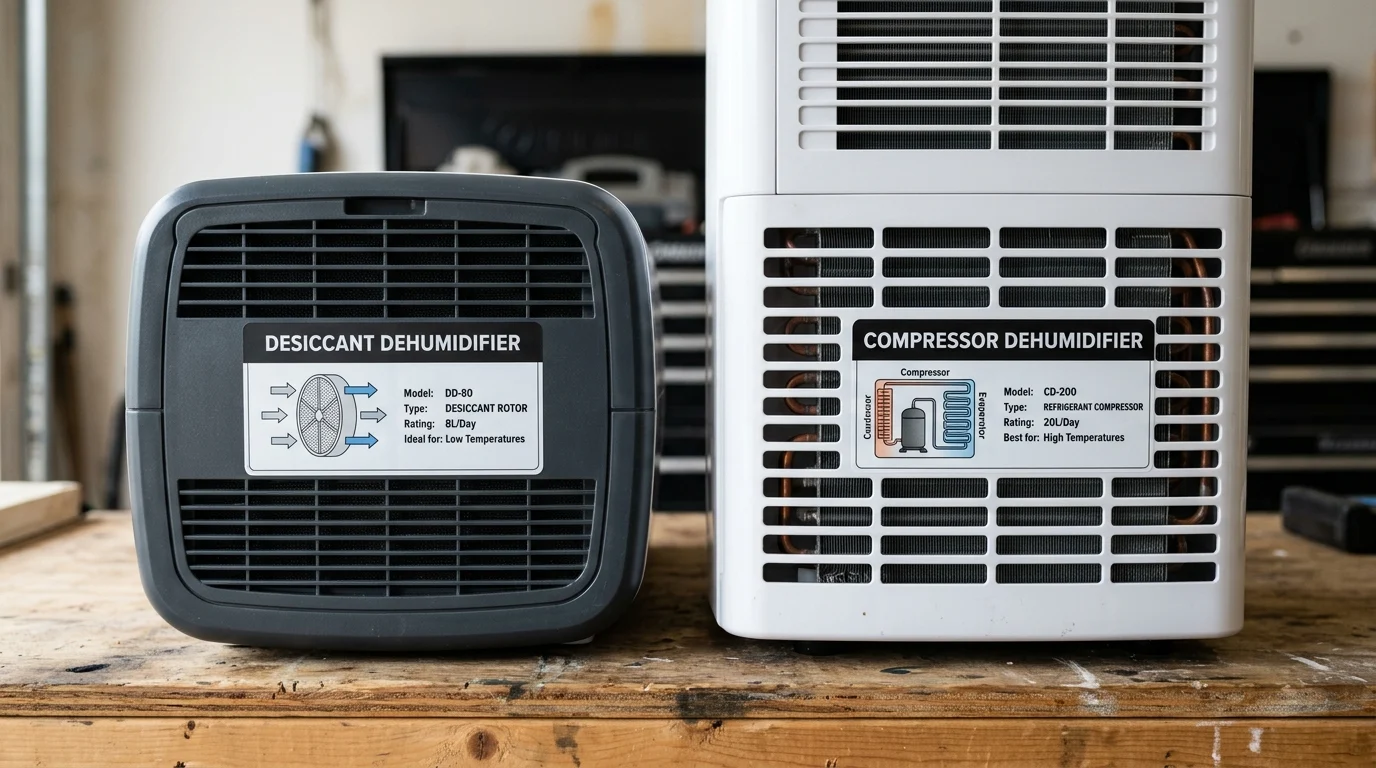
The superiority of a desiccant or compressor dehumidifier is entirely contextual. Engineers and facility managers must cross-reference the environmental baseline against the desired atmospheric outcome. Forcing a compressor unit to perform in sub-optimal conditions, or over-specifying a desiccant unit for a standard warm-weather application, inevitably leads to severe inefficiencies.
When is a desiccant dehumidifier better for cold spaces
Desiccant technology is unequivocally the better choice for cold environments. Because compressor units rely on chilling coils below the dew point, their efficiency plummets as ambient temperatures drop. Below 15°C, frost begins to form on the evaporator coils, forcing the machine into energy-wasting defrost cycles, and below 5°C, condensation-based extraction essentially ceases. Desiccant rotors, however, do not rely on condensation. They maintain a nearly flat moisture extraction curve even at 1°C or in sub-zero freezers, making them indispensable for cold storage facilities, unheated warehouses, and ice rinks.
When is a compressor dehumidifier better for warm rooms
Conversely, compressor dehumidifiers excel in warm, humid spaces. In environments where temperatures exceed 20°C and relative humidity is high (e.g., indoor swimming pools, commercial laundries, or tropical climates), the high dew point allows the evaporator coils to condense massive volumes of water rapidly.
Under these optimal conditions, a compressor unit can achieve exceptional energy efficiency, frequently extracting 1.5 to 2.5 liters of water per kilowatt-hour (kWh) consumed. A desiccant unit in the exact same environment would consume significantly more power to run its reactivation heaters for an equivalent volume of moisture removal.
What decision criteria should buyers use
When establishing procurement parameters, buyers should utilize a psychrometric decision matrix. The primary thresholds are ambient temperature and target RH.
| Decision Criteria | Recommend Desiccant | Recommend Compressor |
|---|---|---|
| Ambient Temperature | Consistently below 15°C | Consistently above 15°C |
| Target Relative Humidity | Strict control below 45% RH | General comfort above 45% RH |
| Target Dew Point | Requires sub-zero dew points | Dew point above 10°C is acceptable |
| Installation Limits | Ducting to exterior is available | Gravity drain or pump is available |
How do desiccant and compressor dehumidifiers compare on performance and
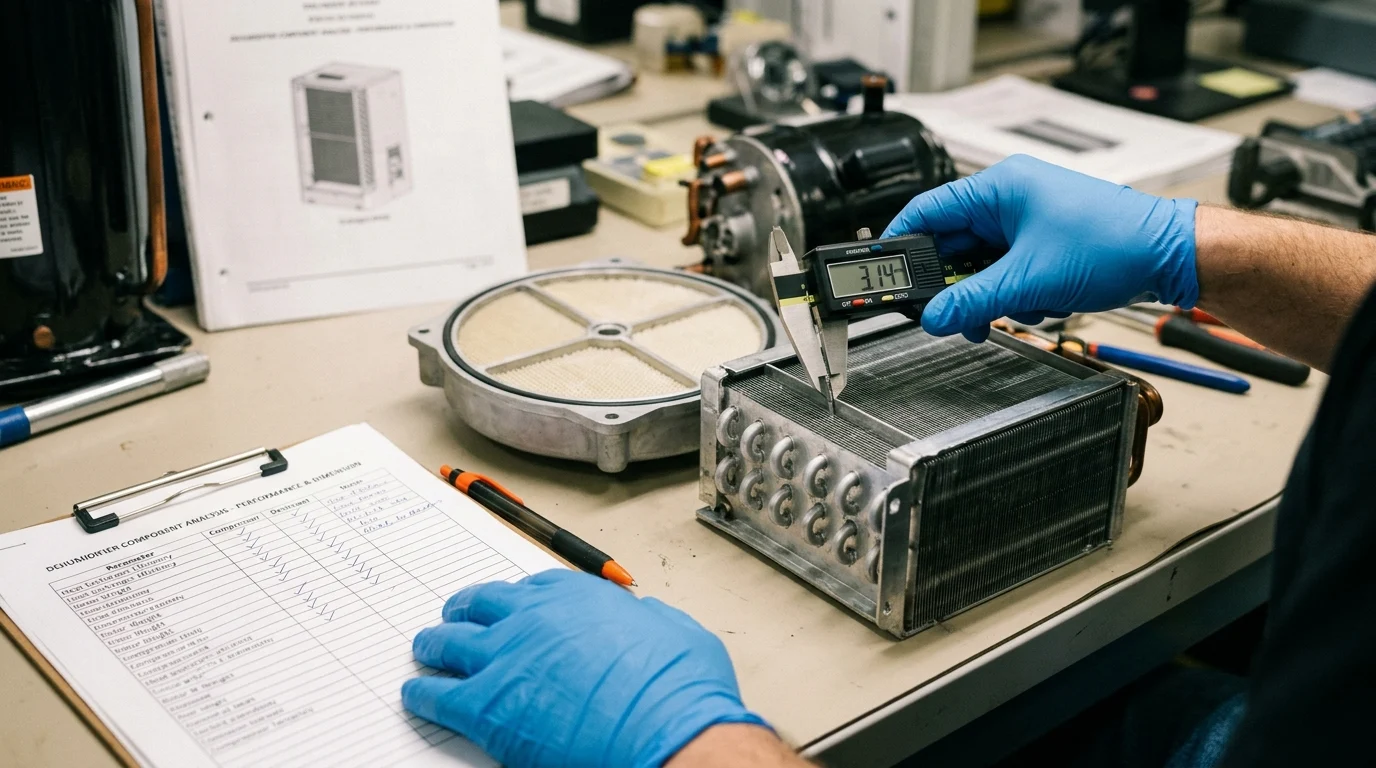
Beyond thermodynamic capabilities, the total cost of ownership (TCO) heavily influences the procurement decision. This encompasses the initial capital expenditure (CAPEX), ongoing operational expenditure (OPEX) driven by energy consumption, and the lifecycle maintenance requirements of the respective technologies.
How does humidity control affect energy use and drying speed
Humidity control directly impacts energy consumption and drying speed, but the energy vectors differ. Compressor units utilize mechanical work—typically drawing between 300W and 800W for commercial portable models—to drive the refrigeration cycle. They are highly efficient at removing bulk moisture quickly in warm conditions.
Desiccant units rely primarily on thermal energy for the reactivation heater, often drawing 500W to 1500W or more for equivalent physical footprints. While desiccants consume more energy per liter of water extracted at standard conditions (20°C/60% RH), their drying speed in cold or ultra-dry environments is vastly superior. Compressors experience a logarithmic drop in extraction capacity as humidity falls below 50%.
How do upfront cost, running cost, and maintenance compare
Upfront costs for compressor dehumidifiers are generally 30% to 50% lower than desiccant units of comparable nominal capacity, largely due to economies of scale in compressor manufacturing. Running costs in warm climates also heavily favor compressors.
However, maintenance profiles differ significantly. Compressors involve pressurized refrigerants, mechanical valves, and moving parts susceptible to wear, vibration, and gas leaks. Desiccant units have a simpler mechanical footprint—primarily fans and a low-RPM drive motor—meaning routine maintenance is often limited to filter changes and replacing the desiccant rotor every 3 to 5 years, depending on airborne contaminant loads.
What installation and sourcing factors affect total value
Installation constraints can fundamentally alter the total value proposition. Compressor units produce liquid condensate, requiring a reliable gravity drain or a condensate pump capable of handling the requisite lift (often rated for 3 to 5 meters of vertical head).
In contrast, desiccant dehumidifiers do not produce liquid water; they exhaust moisture as a warm vapor. This necessitates ducting the wet reactivation air to the exterior of the building. Standard commercial desiccant units typically require ducting diameters ranging from 100mm to 150mm. If penetrating the building envelope for exhaust ducting is structurally prohibited or cost-prohibitive, a compressor unit may become the only viable option by default, regardless of thermal efficiency.
What is the practical conclusion when choosing between desiccant and
Selecting between desiccant and compressor dehumidifiers is not a matter of one technology being universally superior to the other; rather, it is an exercise in matching the psychrometric mechanics of the equipment to the specific load requirements of the facility.
How should decision-makers balance performance, cost, and use case
Decision-makers must balance performance, lifecycle cost, and the specific use case by conducting a thorough environmental audit. Compressors remain the robust workhorses for standard climate control, excelling in residential basements, indoor agriculture, and high-temperature manufacturing where bulk moisture removal is prioritized and ambient temperatures remain above 15°C.
Desiccants serve as precision instruments for specialized environments—such as pharmaceutical tableting rooms, archival storage, and cold chain logistics—where maintaining strict RH below 45% or operating in freezing conditions is mandatory.
Deploying the wrong technology for the application is a costly error; running a compressor unit in a cold environment can increase energy consumption by up to 60% due to continuous defrost cycling, while yielding negligible moisture extraction. Therefore, mapping the required dew point and baseline temperature must always precede the final procurement decision.
Key Takeaways
- The most important conclusions and rationale for desiccant vs compressor
- Specs, compliance, and risk checks worth validating before you commit
- Practical next steps and caveats readers can apply immediately
Frequently Asked Questions
What is the main difference between desiccant and compressor dehumidifiers?
Desiccant units adsorb moisture on a rotor and use heat to regenerate it. Compressor units cool air below dew point so water condenses on coils and drains away.
When should I choose a desiccant dehumidifier?
Choose desiccant for cold spaces, low-RH targets, or sub-zero dew points, such as cold storage, unheated warehouses, and ice rinks.
When is a compressor dehumidifier the better option?
Use a compressor unit in warm, humid rooms above about 20°C where you want efficient bulk water removal, such as laundries, pools, or tropical environments.
Which specifications matter most when comparing desiccant vs compressor models?
Check operating temperature range, extraction capacity at your actual conditions, and the minimum RH or dew point the unit can reliably achieve.
Can a compressor dehumidifier work well in cold conditions?
Not usually. Below roughly 15°C, efficiency drops and defrost cycles increase; around 5°C, moisture removal becomes very limited.