
Indoor humidity control has become a practical necessity in many regions, especially where moisture levels regularly exceed 60% RH. This in-depth review of a popular home dehumidifier evaluates real-world performance, energy efficiency, operating noise, and long-term value while comparing several leading residential moisture-control categories.
Modern home dehumidifiers now combine humidity sensors, smart controls, and low-noise compressors to improve indoor comfort while reducing mold risk and protecting furniture, electronics, and flooring. According to industry guidance, the ideal indoor humidity range remains 40%–60% RH. (saitesi)
Why a Home Dehumidifier Matters in Modern Homes
A reliable home dehumidifier improves indoor air quality by reducing excess moisture before mold and dust mites develop. Excess humidity also damages wood flooring, fabrics, paper storage, and electronic equipment. (saitesi)
The latest residential moisture-control systems typically target medium-sized living areas between 25㎡ and 45㎡. Current consumer demand focuses on four priorities:
- Stable moisture extraction capacity
- Lower electricity consumption
- Quiet nighttime operation
- Automatic humidity management

Main Home Dehumidifier Categories Available
The current market includes several major product categories designed for different humidity conditions and room sizes.
| Product Category | Typical Capacity | Best Use Case | Key Advantage |
|---|---|---|---|
| Portable Mini Dehumidifier | 1–5L/day | Closets, RVs, small bedrooms | Compact and quiet |
| Home Compressor Dehumidifier | 10–30L/day | Apartments and living spaces | Balanced performance |
| Commercial Dehumidifier | 30L+/day | Warehouses and large basements | Heavy-duty extraction |
| Quiet Bedroom Dehumidifier | 10–16L/day | Sleep environments | Reduced noise output |
The Cetus product ecosystem currently includes several relevant categories, including:
- Portable Home Dehumidifier Collection
- 10L/12L/16L Dehumidifier Series
- Quiet Bedroom Dehumidifier Guide
- Commercial Dehumidifier Solutions
- Home Dehumidifier Sizing Guide
Performance Review of a Popular 12L Home Dehumidifier
The 12L compressor-based home dehumidifier stands out because it balances capacity, energy use, and residential usability. According to manufacturer specifications, the unit removes up to 12 liters of moisture per day under 30°C and 80% RH test conditions. (saitesi)
Moisture Removal Performance
The strongest aspect of the 12L unit is stable humidity reduction in medium-sized rooms. During continuous operation, humidity can typically decrease from approximately 75% RH to 50% RH within several hours, depending on airflow and room sealing.
Key operating specifications include:
| Feature | 12L Home Dehumidifier |
|---|---|
| Daily Capacity | 12L/day |
| Recommended Area | 25–45㎡ |
| Noise Level | ≤42dB |
| Water Tank | 4L |
| Refrigerant | R290 |
| Power Consumption | 240W |
The integrated humidistat supports adjustable humidity targets between 20% and 90% RH. This allows automatic cycling once the preferred moisture level is reached. (saitesi)
Airflow and Comfort
The airflow rating of approximately 160m³/h provides adequate circulation for bedrooms, offices, and compact living rooms. Consistent airflow improves moisture extraction efficiency because humid air reaches the evaporator coils more evenly.
Many current compressor-based air dehumidifiers also include:
- Auto defrost mode
- 24-hour timer
- Automatic restart memory
- Multiple fan modes
- Continuous drainage compatibility
These features reduce manual supervision during long-term operation.
Energy Efficiency and Operating Noise
Energy efficiency is now one of the most important evaluation metrics for residential moisture-control equipment. Modern compressor systems consume substantially less electricity than older fixed-speed designs. (saitesi)
A 240W power draw positions the reviewed unit within the efficient range for mid-capacity household dehumidifiers.
Estimated Energy Consumption
| Usage Pattern | Estimated Daily Energy Use |
|---|---|
| 4 Hours/Day | 0.96 kWh |
| 8 Hours/Day | 1.92 kWh |
| Continuous Operation | 5.76 kWh |
Actual electricity cost depends on climate, humidity levels, and local energy pricing.
Noise Evaluation
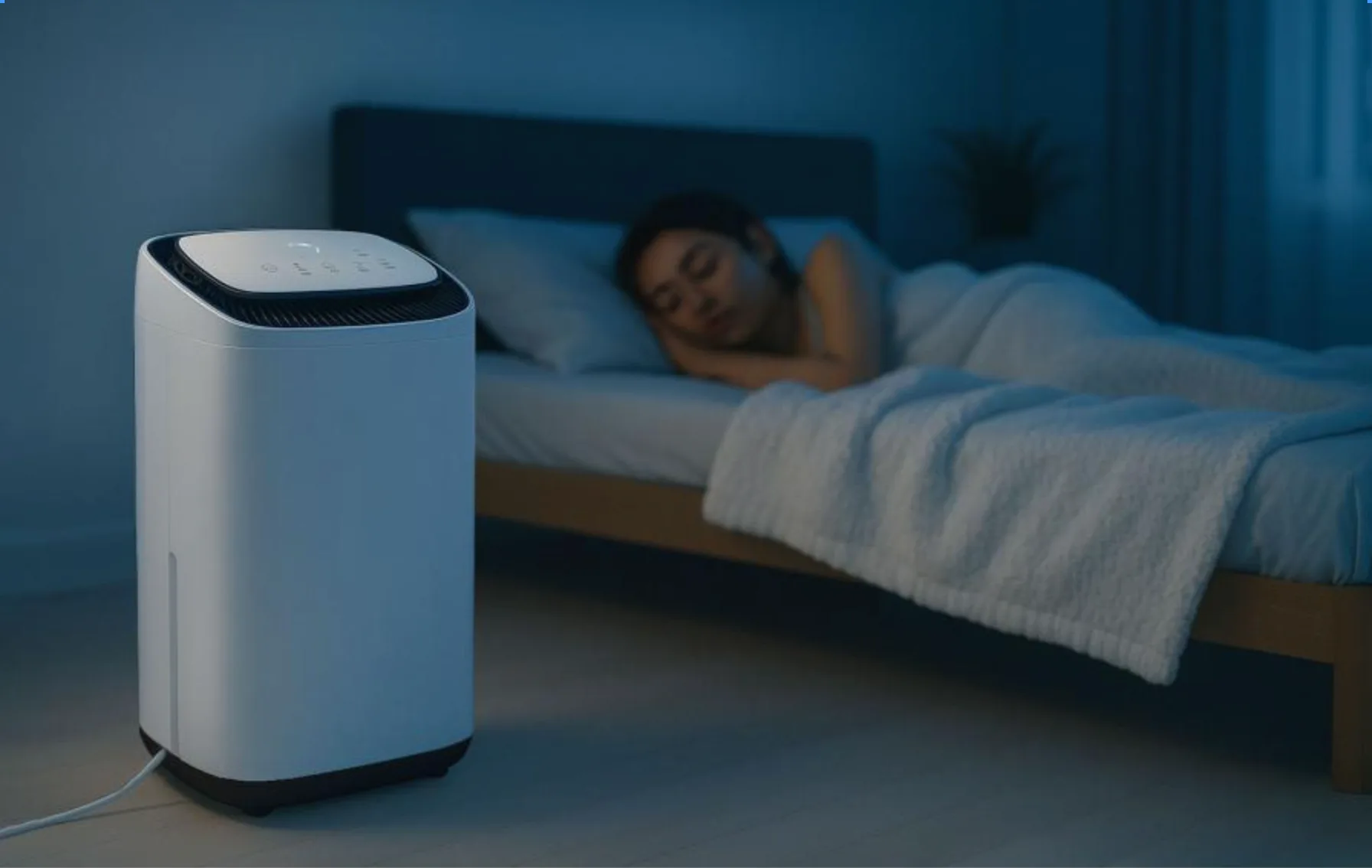
Low operating noise is especially important for bedroom applications. Industry guidance suggests that units below 45dB are generally suitable for sleep-sensitive spaces. (saitesi)
The reviewed quiet home dehumidifier operates at approximately ≤42dB, which is comparable to moderate background conversation or library ambience.
This noise profile is acceptable for:
- Bedrooms
- Home offices
- Nurseries
- Study rooms
Real-World Usage Scenarios for Residential Dehumidifiers
Different room conditions require different moisture-control strategies. A correctly sized home dehumidifier performs more efficiently and experiences less compressor stress.
Apartment and Bedroom Use
A 10L–12L residential dehumidifier is typically sufficient for:
- Bedrooms
- Studio apartments
- Small offices
- Laundry rooms
Lower-capacity units consume less power and generate lower operating noise.
Basement and High-Humidity Areas
Basements often require larger-capacity systems because humidity remains elevated for longer periods. A 16L or higher compressor model generally performs better in enclosed damp environments.
Continuous Operation Applications
Continuous drainage becomes important during rainy seasons or in tropical climates. Models supporting drainage hoses reduce maintenance interruptions and stabilize long operating cycles.
The following external technical resources also support recommended humidity practices and energy-efficiency considerations:
- U.S. Environmental Protection Agency Indoor Air Quality Guidance
- Energy Star Dehumidifier Efficiency Standards
- ASHRAE Indoor Humidity Recommendations
Maintenance Requirements and Long-Term Reliability
Routine maintenance strongly affects dehumidifier lifespan and extraction performance. Dirty filters and blocked airflow reduce efficiency while increasing compressor load. (saitesi)
Recommended Maintenance Checklist
| Maintenance Task | Frequency |
|---|---|
| Clean air filter | Every 2–4 weeks |
| Empty water tank | As needed |
| Check drainage hose | Monthly |
| Inspect evaporator coils | Every 6 months |
| Clean exterior vents | Monthly |
Units using R290 refrigerant are increasingly common because the refrigerant offers lower environmental impact compared with older alternatives. (saitesi)
Final Value Assessment of This Home Dehumidifier
The reviewed 12L compressor-based home dehumidifier delivers balanced performance for medium residential spaces. The strongest advantages include efficient moisture removal, low operating noise, moderate energy consumption, and flexible humidity control.
The model is best suited for:
- Apartments
- Bedrooms
- Home offices
- Moderate humidity regions
The product may be less suitable for:
- Large open-plan homes
- Industrial applications
- Extremely wet basements requiring 25L+ capacity
Overall, the combination of humidity control accuracy, portability, and low-noise operation gives this category strong practical value for everyday residential moisture management.
FAQ
What size home dehumidifier is best for a bedroom?
A bedroom typically requires a 10L–12L home dehumidifier if the room size falls between 20㎡ and 45㎡. Lower-capacity units are usually quieter and more energy efficient. Extremely damp bedrooms or poorly ventilated spaces may require slightly higher extraction capacity.
Is it safe to run a home dehumidifier overnight?
Modern home dehumidifiers are generally designed for overnight operation when equipped with auto shut-off and overflow protection. Units operating below 45dB are usually suitable for sleeping environments. Continuous drainage also reduces the risk of full water tanks interrupting operation.
How much electricity does a 12L dehumidifier use?
Most 12L compressor dehumidifiers consume approximately 200W–250W during active operation. Actual electricity cost depends on humidity levels, room insulation, and operating duration. Smart humidity sensors help reduce energy use by cycling the compressor automatically.
What humidity setting is recommended for indoor comfort?
Most indoor environments remain comfortable between 40% and 60% relative humidity. Lower settings may create dry air discomfort, while higher humidity increases the risk of mold growth, condensation, and dust mites in residential spaces.
Are compressor dehumidifiers better than thermoelectric models?
Compressor dehumidifiers generally remove moisture faster and support larger rooms more effectively. Thermoelectric models are quieter and smaller but usually work best in closets, RVs, or compact enclosed spaces with lighter humidity levels.