
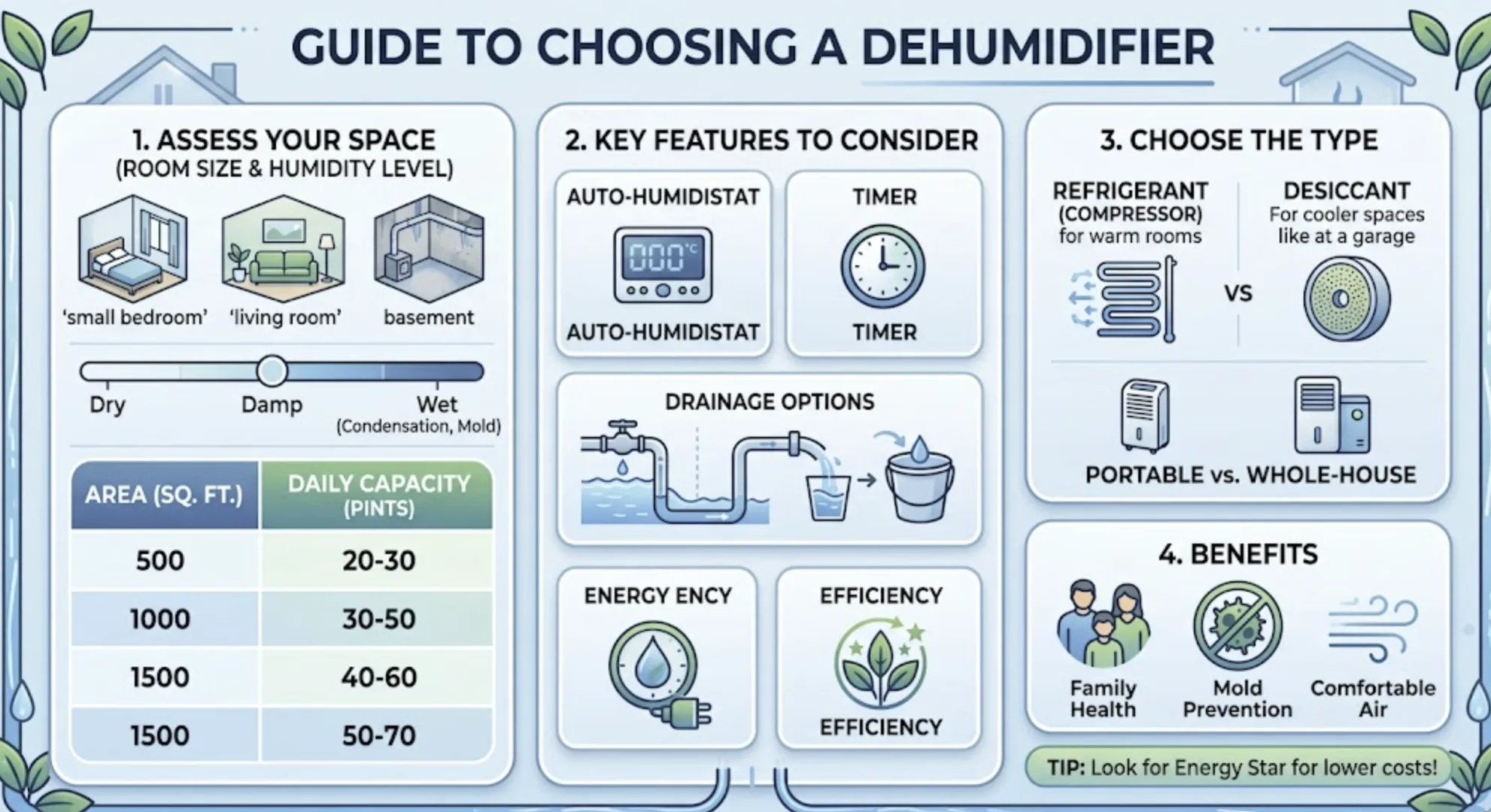
You may be struggling with indoor humidity and think—great! I just need to buy a dehumidifier.
But as you start browsing the market, you quickly realize that the wide variety of dehumidifiers, each with different features and price points, can be overwhelming. Suddenly, you understand—you have no idea which one to choose.
Don’t worry—we’ve got you covered! This simple and easy-to-understand dehumidifier buying guide will teach you how to pick the right unit for your home and finally tackle your humidity problems.
Understanding Key Specifications
To choose the right dehumidifier, match the unit’s dehumidifying capacity to your room size and the level of humidity. Dehumidifying capacity typically ranges from 22 to over 50 pints per day. Key considerations include:
Energy efficiency: Look for models with “Energy Star” certification.
Water tank capacity: Ensure the tank is large enough or the unit has a drainage pump for continuous operation.
Temperature suitability: Choose the type of dehumidifier based on your environment—compressor units for warm areas and desiccant (absorption) units for colder spaces.
Determining Dehumidifying Capacity
-
Small spaces (up to 1,500 sq. ft.): 22–30 pints
-
Medium spaces (up to 2,500 sq. ft.): 30–40 pints
-
Large spaces / extremely humid environments (up to 4,500 sq. ft.): 50+ pints
Assessing Humidity Levels
-
Moderate humidity: Condensation on windows with slight musty odors.
-
High humidity / damp: Damp walls, slippery floors, frequent condensation.
-
Extreme humidity: Standing water or visible mold/mildew.
Adjustment tip: For highly or extremely humid areas, choose a dehumidifier with a capacity one level higher than what the room size alone suggests.
Three Types of Dehumidifiers
Dehumidifiers generally fall into three categories: Peltier (thermoelectric), compressor/refrigerant, and desiccant (absorption) types.
–
Peltier / Thermoelectric Dehumidifiers: Draw humid air over a cold heat sink, where condensation occurs. Water drips into a tank while dry air is released back into the room.
Compressor / Refrigerant Dehumidifiers: The most common type, highly efficient in warm environments.
Desiccant Dehumidifiers: Ideal for lower temperatures, such as basements, with quieter operation.
Key Features and Considerations
-
Drainage method: If the unit cannot be placed near a floor drain, consider a model with a built-in pump for continuous or upward drainage.
-
Auto-defrost: Essential for cold rooms to prevent the coils from freezing.
-
Quiet operation: If placing the dehumidifier in a living area or bedroom, check the decibel rating for noise levels.
Proper Placement
-
Place the unit in the center of the room or directly in problem areas (e.g., a damp basement).
-
Keep at least 6–12 inches away from walls to ensure proper airflow.
How Much Capacity Do You Need?
Here, capacity refers to how much moisture a dehumidifier can remove from the air in 24 hours—not the physical size of the unit. Home dehumidifiers range from around 250 mL to 20 liters per day. You might be surprised at how much water the air actually contains.
Smallest units: 0.25–1.5 liters, suitable for single rooms, boats, or RVs.
The amount of dehumidification you need depends onThe size of the space to manage.
| Environmental Condition | Under 100 sq ft | 150 sq ft | 300 sq ft | 500 sq ft | 600 sq ft | 1000 sq ft |
| Slightly Damp | 250 ml/day | 250 ml/day | 1 L/day | 10 L/day | 12 L/day | 14 L/day |
| Moderately Damp | 250 ml/day | 500 ml/day | 8 L/day | 12 L/day | 16 L/day | 18 L/day |
| Severely Damp | 5 L/day | 7 L/day | 12 L/day | 14 L/day | 18 L/day | 20 L/day |
| Extremely Wet | 7 L/day | 8 L/day | 14 L/day | 16 L/day | 20 L/day | 25 L/day |
Relative humidity of the area
Ambient temperature
Note: Dehumidifier capacity is tested under ideal dry conditions, not necessarily real-world environments.
Quick Size Comparison
| Room Size | Recommended Capacity | Example Usage |
|---|---|---|
|
< 500 sq. ft. |
10–22 pints |
Small bedroom/bathroom |
|
500–1,500 sq. ft. |
22–35 pints |
Living room / medium basement |
|
1,500–2,500 sq. ft. |
35–50 pints |
Large basement |
|
2,500+ sq. ft. |
50+ pints |
Whole house |